
Fake news

  • Misinformation sharing and behavioural pattern of Nigerians on viral Stella Immanuel video

    Summary

    On July 28, Nigerian social media space was flooded with several versions of a video of a woman, identified as Stella Immanuel, among a group of United States’ doctors, vehemently making unsubstantiated claims about hydroxychloroquine and the ravaging COVID-19 pandemic, while dismissing other promoted preventive behaviours. The video went viral globally, generating tens of million in views across social media platforms. The video added to the streams of misinformation on the pandemic with the potential to hinder progress being made in combating the COVID-19 pandemic. The video was fact-checked by several fact-checking organisations and they all dismissed the claims.  In this piece, we examine the virality of the video among respondents, their convictions on the claims made and likely behaviour in the possibility of suspected COVID-19 infection.  Our findings supported virality of the video with more than 90 percent being aware of the video, but with limited shares among respondents. Despite repeated fact-checks, those who still believed claims made in the video were found more likely to try hydroxychloroquine than those who do not. Respondents mostly expressed positive views towards wearing facemasks to limit the spread of the virus. The virality of the video compared to its fact-checks supports the need to stop misinformation from spreading in the earliest possible time. Hence, fact checkers must continuously be alert to track misinformation in the public space and stop its spread immediately.

    Introduction

    Among frequently shared misinformation about the coronavirus is the controversial use of hydroxychloroquine either as a curative or preventive measure to the ravaging pandemic. This was recently heightened with the viral video of a group that called itself America’s Frontline Doctors. On July 27, members of the group appeared before the United States Supreme Court in branded white coats and made a series of claims dismissing official response and measures to curtail the pandemic. The choice of the Supreme Court frontage was probably to lend credence to the group.  

    Among vehement speakers at the event is a controversial Nigerian-trained US-based doctor, Stella Immanuel, who made unsubstantiated claims regarding hydroxychloroquine as a cure to COVID-19 and dismissed wearing of face masks. Days later, Stella Immanuel claimed she was on a spiritual mission to save the world. Others in the video might also be of questionable personality, with this report indicating little evidence most had worked as COVID-19 frontline workers as suggested by the group’s name. 

    Soon after the group released the video, President Trump retweeted the video and it went viral thereafter. Several versions of the video were shared across social media platforms. The New York Times reported a version with 16 million views on Facebook alone. It was also a leading performing post on Twitter with over 14 million views.  This is despite the fact that social media companies removed the video within hours of its upload.  Not surprisingly, the video reignited widespread interest in potential use of hydroxychloroquine in combating the coronavirus pandemic. No doubt, Hydroxycloroquine has shown promising results in the management of COVID-19 cases in many societies. Recently, Director General of NAFDAC, Prof. Mojisola Adeyeye, reported positive outcomes in its use at the early stage of COVID-19 infection. Several studies are ongoing globally, with no consensus yet among the scientific community.  There has also been a call for local efforts in dealing with the global pandemic based on the peculiarities of each society. Recently, when the WHO initially called for a halt in clinical trials on the use of Hydroxycloroquine to treat the virus, NAFDAC continued its approval locally.

    Existing controversy within the scientific community might thus be adding to the confusion among the general public.  Experts continue to denounce Immanuel’s claims as “personal opinion, which has no scientific backing and could simply be regarded as “unsubstantiated claims” to “be taken with a pinch of salt”. To the layman, however, she is the courageous doctor ready to go against all odds to halt the spread of the pandemic.

    The video has since been debunked by fact-checkers (e.g.  Dubawa, Africa Check, Politifact), confirming that hydroxycloroquine is not yet approved as a cure for COVID-19, since research is still ongoing to test the efficacy of the drug. In this piece, we examine how selected Nigerians perceived this viral video and their subsequent reaction following the “FALSE” verdict of fact-checkers. Specifically, we examine the virality of the video among respondents and their perception of the claims made before and after reading any of the fact-checks.

    Method

    This study adopted the online survey method using google form to prepare a 21-item questionnaire. The questionnaire’s link was shared through WhatsApp messaging app for people to respond to, with an additional message for recipients to help share among their contacts.  Responses were gathered over a two-week period from Saturday, August 8 to Saturday August 22, 2020. A total of 222 respondents filled the questionnaire from across the country and beyond, but with the South-west recording dominance.  The respondents comprise 54 percent male and 46 percent female. The age distribution of respondents is presented in the pie chart below.
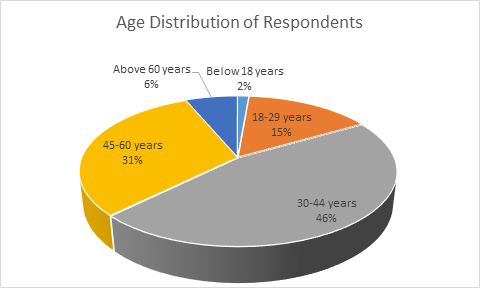
    Figure 1

    Findings

    Findings from this study support the virality of the video. Ninety percent of respondents confirmed familiarity with the video. Seven percent said they were not aware of the video while about 3 percent were unsure if they had seen the video.  Majority of respondents confirmed seeing the video on more than one social media platform. Less than 20 percent confirmed sharing the video. WhatApp and Facebook led single platforms through which people saw the video. 
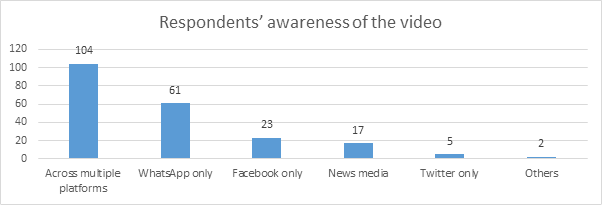
    Figure 2

    Across age groups, 80 to 100 percent of respondents confirmed seeing the video.  The elderly population (above 60 years) more readily shared the video. Half of respondents over 60 years confirmed sharing the video.

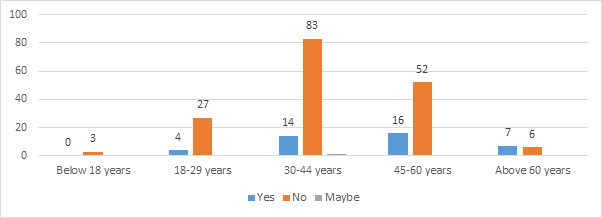
    Figure 3
    Figure 4

    Respondents mostly expressed neutrality in believing her claims, but with more denouncing her claims than believing it.  Those neutral about the claims and those with higher belief in the claims shared the video more than those with less conviction about the claims.  Some of those who believe her claims noted they were persuaded by her convincing oratory which according to them was “detailed with proof.”  Other reasons for believing her claims were  confirmation of their previous suspicion of a cure, lingering controversies within the scientific community, support based on success in clinical trials locally and shared experiences of recovered covid-19 patients Those who considered the claim a hoax noted their ingenuity of covid-19 misinformation and said they considered the “staged event” a “political propaganda” with unsubstantiated claims which should be viewed with scepticism, among others.
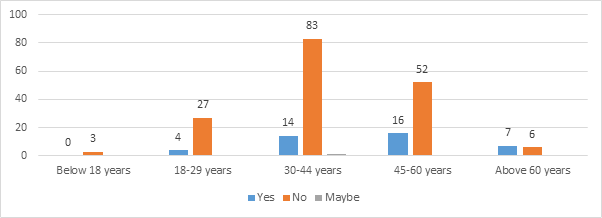
    Figure 5

    Soon after the video went viral, other social media posts emerged to counter the claims in the video even before fact checks were published on the claims. One hundred and forty-six (146) respondents confirmed reading the countering social media posts even though the majority still remained resolute in their beliefs on the claims made.
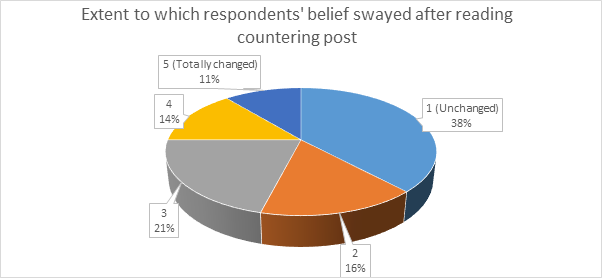
    Figure 6

    In the days following the release of the video, several fact checking organisations published fact checks on claims made in the video, amid other elements such as the so-called America’s Frontline Doctors, and individual members who featured in the video. Almost Forty-four percent (43.9%; n=94) of respondents confirmed awareness of the video fact-check while a slightly higher percentage (44.4%, n=95) claimed not to be aware. Another 12 percent were unsure of themselves.  Of the 94 respondents who confirmed awareness of the fact-checks, only 68 percent confirmed reading it.  

    Respondents mostly became aware of fact checks on the video after seeing online posts of fact check debunking claims made in the video. Many also found out about it through shared posts on the fact checks or were notified by social media platforms. Few respondents reported learning about the fact checks through news mention mostly on notable news media organisations such as Cable News Network (CNN) and Channels TV.

    How respondents knew about the fact-checking?Percentage of Respondents aware of fact-checking on the video
    I saw the post of the fact-checked article36%
    Someone shared the fact-checked article with me30%
    I was notified on social media27%
    News media mention7%
    Total(n)100%(94)
    Table 1: How respondents aware of fact-checking of the video knew about it

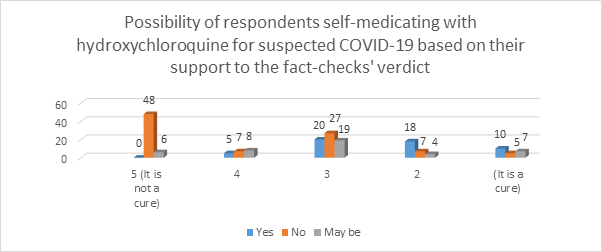
    Respondents in the study were neutral in supporting fact-checkers’ verdict on claims made in the video.  The greatest percentage (35%) of respondents gave average scores to their support of the false verdict of fact checkers.  However, the percentage of those supporting the verdict (Rated 4 and 5) are generally higher than those opposing it (Rated 1 and 2).  Those opposing fact checkers’ verdict confirmed their likelihood to take hydroxychloroquine (or in combination other drugs) to prevent COVID-19 in contrast to those supporting it.  Similarly, those indecisive (rated 3) and those not supporting fact-checkers’ verdict (rated 1 and 2) were found more likely to self-medicate with hydroxychloroquine if they suspect they might be infected with COVID-19.
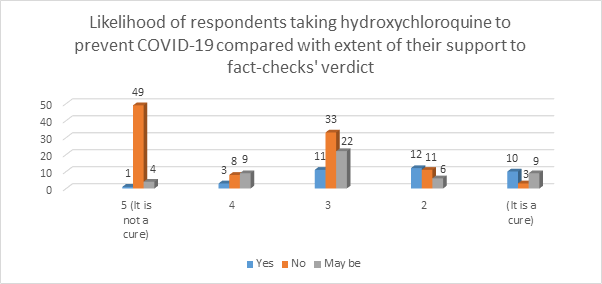
    Figure 7

    Respondents expressed diverse views on promoted behaviours in the video. Majority of respondents simply expressed support for wearing facemask while a few more supported the idea with notable caution.  Another dominant view focused on its preventive capability, emphasising its need to curb the spread of the virus. However, some considered the preventive ability of facemask to be relative based on specific circumstances. Less dominant views considered wearing facemask simply as a civil behaviour in obedience to official directive. Others deemphasised its necessity in curbing the virus, noting it generally filters the air we breathe in and prevents common air-borne disease. Few respondents considered it unnecessary and/or ineffective in limiting the spread of the virus while few others focused on its limitations and considered it to be hazardous suggesting it might be risky for some with underlying breathing challenges. Others were indifferent or considered wearing facemask as an individual’s choice.

     Views on wearing masksFrequencyPercentage
    Support the idea8038.3
    Preventive7736.8
    Official directive125.7
    General prevention115.3
    Support the idea with caution115.3
    Relatively preventive52.4
    Ineffective / unnecessary52.4
    Hazardous31.4
    Indifferent31.4
    Others21.0
    Total209100.0
    Table 2: Themes in Respondents’ views on wearing masks

    Figure 8

    Respondents sharing video?Respondents’ sharing fact-check?Total
    YesNo
    Yes6%12%18%
    No13%69%82%
    Total(n)19%(37)81%(159)100%(196)
    Table 3: Respondents’ sharing of the video and its fact-check?

    Generally, the level of information sharing on the video appears to be minimal among respondents. As noted in table 10, the extent to which respondents shared the original video and its subsequent fact checks is minimal, occurring in less than 20 percent in both cases.

    Conclusion

    Findings from the study above confirm earlier observations that fact checks do not often attain the virality of misinformation posts they countered. As noted by Funke (2019), this need not discourage fact checkers as there have also been several promising results on potential of well-written fact checks to change people’s misconceptions. Fact-checkers must learn to debunk misinformation without further promoting the misinformation, by limiting detailed references to the debunked claims.

    Efforts of giant social media platforms, though commendable, need to be intensified to stop the spread of misinformation as early as possible. For instance, the viral video examined in this study had been viewed more than 14 million times on Twitter and 16 million times on Facebook before its removal. Despite that, it is still likely available among millions of social media users who had downloaded it to their device’s memory while still available.  No doubt, the number of views would have been much higher had it been left online.  Fact checkers thus have to be increasingly alert to stem the spread of misinformation through prompt publication of their fact checks and aggressive promotion of their fact checks.

    Download a PDF version below

  • “Fake News”: Understanding the Scourge in Nigeria

    Executive Summary

    There have been studies conducted on what exactly constitutes “fake news” and its variants. Researchers have looked into the Nigerian examples of ‘fake news’, its mode of transmission, the reasons it spreads in Nigeria, its impact on our democracy as well as possible structural solutions to the menace. 

    Yet, there is a need for a holistic view of the issues around the scourge within the Nigerian context. This article adopts the method of contextual analysis of a selected studies, situating the studies within the Nigerian milieu, assessing the positions of the authors, experts, readers (including offline and online audience) and other texts to understand the scourge. 

    The study finds out that ‘fake news’ thrives in Nigeria in its different variants. These variants include misinformation, disinformation and mal-information. It finds out that the nation’s culture of ‘closed’ (as opposed to open) governance, which thrives on official secrecy and dearth of timely official information is a recipe for the scourge to spread. It also finds out that increased Nigeria’s population on social media and other digital space is an escape route from muffled voices in the mainstream; an avenue to create, share and distribute contents of all sorts, many of which populate the misinformation ecosystem in Nigeria.  

    This study’s contribution to knowledge is underscored in how it justaposes selected past research on ‘fake news’ in Nigeria and analyses contextual factors and  impacts of fake news proliferation. The study therefore recommends among other deliverables, aggressive engagements with online and social media users whose increased media literacy will help reduce the spread of ‘fake news’ in Nigeria.    

    Introduction

    Collins dictionary says “fake news” is “false, often sensational information disseminated under the guise of news reporting” (independent.co.uk). Ethical Journalism Network says “fake news” is information deliberately fabricated and published with the intention to deceive and mislead others into believing falsehood or doubtful messages. The British Broadcasting Corporation (BBC) defines fake news as “completely false information, photos or videos purposefully created and spread to confuse or disinform (Umaru Pate, et al, 2019).

    New insights have thrown up the reasons the term should be explained, rather than be defined because of the damage or its impact on the legitimacy of news media. One of these voices was Cherilyn Ireton and Julie Posetti (2018) who posited, in their UNESCO report that “fake news” and whatever it represents revolve round three typologies: Misinformation, Disinformation, and mal-information. In their position, they said:

    It can be helpful, however, to propose that misinformation is information that is false,  but the person who is disseminating it believes that it is true. Disinformation is information that is false, and the person who is disseminating it knows it is false. It is a deliberate, intentional lie, and points to people being actively disinformed by malicious actors.  A third category could be termed mal-information; information, that is based on reality, but used to inflict harm on a person, organisation or country

    The above description shows different levels of information disorder ecosystem.

    • One, it shows “fake news” as a form of misinformation that contains misleading content;
    • a form of disinformation that thrives on false context, imposter content, manipulated and fabricated content;
    • It can also be a form of mal-information which highlights some content around hate speech, stereotype and blackmail among others.

    One or more of this information disorder have pervaded our national lives. They have infiltrated the media, government institutions, democratic and development agencies, private sectors and civil societies. There have been studies conducted on what exactly constitutes “fake news” and its variants. However, there have been more raging questions around misinformation ecosystem than researchers have been able to provide answers to. What is the recurring dimension of the mode of transmission in Nigeria? What has been deduced as the factors influencing the spread in Nigeria? What are the impacts of continued spread and transmission of false information on our democracy as well as possible structural solutions to the menace?. This study seeks to harmonise the findings of the existing literature to provide answers to the above questions. Sequel to the foregoing, the objectives of this study include:

    1. To review existing literature which has covered the scope of the typology of misinformation ecosystem in Nigeria;

     2. To highlight cases of information disorder in Nigeria;

    3. To identify from existing literature the reasons for the spread of misinformation, its mode of transmission and its impacts on the Nigerian democratic setting.

    Contextual Analysis:

    This study relies on the method of contextual analysis of a selected studies, situating the studies within the Nigerian milieu, assessing the positions of the authors, experts, readers (including offline and online audience) and other texts to understand the scourge. Gisele Marie Tierney (1986) adopted this method as developed by Scheflen (1973) and Jones and Yarbrough (1985), and also adapted it to accommodate the distinct elements of communication strategy use in the context of dyadic interactions. 

    Contextual analysis is simply an analysis of a text that helps us to access that text within the context of its historical and cultural setting , but also in terms of its textuality or the quality that characterises the text. Leveraging on how contextual analysis works, researchers most often rely on some critical questions that will aid their work. These questions include: what does the text reveal about itself? What does the text tell us about its audience? What are the author’s intentions? What is the occasion for this text? Is the text calling for actions? Can we identify any non-textual circumstances that affected the creation and reception of the text?   

    In essence, contextual analysis as a concept reveals the social, political, cultural, economic, philosophical and aesthetic conditions that existed at the time and place when the text was created. Gisele Marie Tierney (1986) says “contextual analysis provides a necessary cross-situational approach to communication research”, aiding researcher to make decisions regarding which variables to be addressed after data have been collected   

    Victoria Phelps (2015) argues that when one analyses a piece using contextual analysis, one focuses on the environment in which the text was produced. Others key areas to focus on include some parameters that may explain why the author holds a certain stance. Since the issue around misinformation ecosystem is understood differently, depending on the context, the adoption of contextual analysis by this study is justified. In some settings, fake information appears mostly as hoax, satire and parodies and contained in audio-visual format. All these will be discussed and understood differently from others mostly in written format. For instance, much of the fake information posted on the internet during the 2016 presidential election in America appeared in written text and recorded segments (Denise-Marie Ordway, 2017). In Nigeria, study has shown official personalities and political actors were found to spread fake information during the 2019 presidential election (Paul Anderson, 2019).

    This study seeks to build on the existing literature by harmonising their findings on ‘fake news’ as well as proposed solutions to curb its spread. Umaru Pate et al (2019) finds out that “fake news” spread because there is general distrust of elites, leaders and politicians by majority of Nigerians, sensationalization of fake news disseminated for economic, political, and cultural reasons, especially on social media and the desperation by politicians, ethnic and religious jingoists, foreign interests and mischief makers to generate fake news for influence or to persuade the audience. Cherilyn Ireton and Julie Posetti (2018) also opine that the spread of disinformation and misinformation is made possible largely through social networks and social messaging, which begs the question of the extent of regulation and self-regulation of companies providing these services. David M.J et al (2018) leverage on the social and computer science research regarding belief in fake news and the mechanism by which it spreads. Thay find that the rise of ‘fake news’ has not only taken a politically-oriented incarnation but also highlights the erosion of long standing institutional bulwark against misinformation in the internet age.

    Just as Denise-Marie Ordway (2017) pulled together academic studies to help newsrooms better understand information ecosystem in Europe and America, as well as its impacts, this study also digs into the psychological and socio-political context of the Nigerian experience of various authors, contextualising their thoughts on the problem in order to find a common ground on its solutions. As Denise-Marie opines, news media has written a lot about fake news and other forms of misinformation, but scholars are still trying to understand it — for example, how it travels and why some people believe it and even seek it out .

    The Nigerian Context

    A Study conducted by the Center for Democracy and Development and the University of Birmingham on WhatsApp’s role during Nigeria’s 2019 elections, cited parents and grandparents as the “biggest sharers” of misinformation (QuartsAfrica, 2019). Others such as jokers, scammers, politicians, conspiracy theorists, insiders, relatives and celebrities are among the perpetrators of misinformation (BBC, 2020). Quite a number of hoax being spread in Nigeria include:

    •  A false report peddled after the 2015 general elections that the Independent National Electoral Commission had determined that under-age youth in northern Nigeria had voted in the elections. The claim caused a serious uproar among the public and opposition parties (Amobi, 2019);
    • A report which claimed that the killings of 86 people in 11 communities in Barkin Ladi, Riyom and Jos South local government areas of Plateau State on June 23, 2018, were retaliatory and credited the statement to Miyetti Allah Chairman Danladi Ciroma. However, the report was found to be false following a new report that revealed Ciroma had actually been misquoted (Okunola, 2018).
    • A tweet by President Buhari’s Special Adviser on Social Media, who in the lead to 2019 election posted a video on Twitter which showed the president’s supporters at a big rally when in reality the images were from a religious gathering the year before was an example of disinformation (Paul Anderson, 2019).
    • Another example of disinformation was a tweet by the same presidential aid accusing Mr Abubakar of sharing food and money during his campaigning. It came with a photo of food packs with money attached and a caption saying: “Keep them in poverty, then give them handouts. Atiku in Sokoto yesterday.” (Paul Anderson, 2019)

    Fake News: Why it spreads in Nigeria

    The growth of Nigerian population has witnessed an alarming rate from about 40million in 1960 to approximately 200million in 2019 (World Bank, 2019). This means the quantum of information needed by the citizens to make informed choices should alos be upscaled. On the contrary and given this huge figure, what has happened is a weakened and ill-informed populace. one major issue confronting the nation is the mode of governance that is shrouded in secrecy, with no timely and adequate information about the running of the state. So, where the public cannot access factual and reliable information either from the government or the media, it is expected that rumour, hoaxes, falsehood and outright lies fill the gap. With government and state actors, having muffled the public voices in the mainstream, and with the democratization of the digital space, millions of Nigerians have found willing collaborators in the social media, search engines and other enable sites to produce, distribute, share information and form communities. Some of the practical reasons “fake news” spread in Nigeria have been highlighted.

    Umaru Pate et al (2019) state that “fake news” spread because there is:

    • General distrust of elites, leaders and politicians by majority of Nigerians.
    • Absence or most often late arrival of official information on issues.
    • Sensationalization of fake news disseminated for economic, political, and cultural reasons, especially on social media;
    • Desperation by politicians, ethnic and religious jingoists, foreign interests and mischief makers to generate fake news for influence or to persuade the audience;
    • High level of authoritative lies from government sources at all levels.

    Mode of Transmission

    Greater percentage of misinformation in Nigeria is transmitted via the internet, particularly on social media, judging from Amobi (2019) that instant messaging platforms are among the greatest purveyors of misinformation and disinformation and that “false claims are on the rise in Nigeria, partly because of citizen journalism, where there is stiff competition to be the first to publish information”. With the population of Nigerian internet and social media users witnessing a surge in recent times, this makes our democracy more susceptible to misinformation disoder. 

    According to Datareportal (2020), as at January 2020, there were 85.49million internet users in Nigeria, a number increased by 2.2million (at 2.6%) between 2019 and 2020. Taking from the above statistics, 27 million Nigerians were social media users as at January 2020 with an increase of 3.4million (at 14%) between April 2019 and January 2020. The take away from the above implies the level of engagement on the part of Nigerians with the digital and socia media.  On this note, we can then draw a connection between the American context where most fake news spread via the internet in written text and recorded segments (Denise-Marie Ordway, 2017), and the Nigerian context where study has shown official personalities and political actors were found to spread fake information using the social media (Paul Anderson, 2019).

    Fro instance, statistics on the presence on social media show that WhatsApp is the most-used social media platform (94%) by Nigerians, followed by Facebook (87%), YouTube (76%), and Instagram. Others include (67%) FB messenger (66%), Twitter (50%), LinkedIn (33%), SnapChat (26%), Pinterest (21%), Skype (14%), Tic Tok (13%), We-Chat (5%), ReDoIt (5%), Viber (5%), Tumber (5%) and Slack (3%).

    This explains the level of internet penetration in Nigeria and how viral messages can travel in the digital space within a few hours. This also explains why the government and other critical stakeholders need to double down on media literacy targeting Nigerians, particularly young people who are very active on social media to know what to share, when to share, how to verify every trending information.

    Table showing most-used social media platforms by Nigerians as at January, 2020

    WhatsAppFacebookYouTubeInstagramFB messengerTwitterLinkedInSnapChatPinterestSkypeTicTokWe ChatReDoItViberTumberSlack
    94%87%76%67%66%50%33%26%21%14%13%5%5%5%5%3%

    Courtesy: datareportal.com

    “Fake News”: Its Impacts in Nigeria

    Experts have construed negative impacts of fake news under three categories:

    • First, the problem of increasing fragmentation and politicisation; ‘
    • Second, the promotion of “safe news” at the expense of difficult or challenging news stories;
    • Third, the need for credible sources to allocate ever-diminishing resources to debunking inaccurate information (which poses both financial and reputational costs).—(Information Society Project, 2017)

    Fake news is weaponized by many actors to further widen our national woes for personal and selfish goals. These actors include politicians, spin doctors, social-cultural, ethnic and religious bigots. The Information Society project at Yale Law School (2017) highlights impact of fake news on any democratic system:

    fake news “devalues and delegitimizes voices of expertise, authoritative institutions,  and the concept of objective data—all of which undermines society’s ability to engage in rational discourse based upon shared facts”.

    Mr. Lai Mohammed, Nigeria’s Minister of Information and Culture underscores impacts of fake news on democratic institutions like the media:

    For the media, the epidemic is even worse. This is because fake news, in most cases, is designed to misinform, undermines confidence in the media. And once the people lose confidence in the media, the society is in trouble.” (Premium Times, 2018). 

    Structural Solutions to Fake News in Nigeria

    While the Nigerian government has launched a “public campaign against fake news” (Premium Times, 2018) and has also launched “campaigns to media houses and cooperation with Facebook and Google” (AllAfrica, 2020), other experts have added some therapies, and these include:

    • Supporting the increasing number of fact-checkers (Paul Anderson, 2019)
    • Need for increased media literacy for the public, particularly young people (Umare Pate, et al, 2019)
    • Other social media platforms should copy from Twitter in restricting number of text user can post and identification of a verified account (Fredrick Wilson and Muhammad Umar, 2019)
    • Journalists… should be very careful about making mistakes.( Adaobi Tricia Nwaubani, BBC 2020)
    • Media should bring the work of independent fact-checking groups to larger audiences (Cherilyn Ireton and Julie Posetti, Unesco, 2018))

    Conclusion

    This article has shown that “fake news” in Nigeria takes the form of misinformation, disinformation and mal-information and has also highlighted some case studies within the Nigerian context. Adopting the concept of contextual analysis, the study shows that the huge Nigeria’s population has found solace and voices on the digital and social media to fill the gap left behind by lack of or inadequate credible and factual information from the mainstream media and official quarters. The impact of this is underscored in how millions of social media users produce, distribute and feed massive unverified information to the disadvantage of official and legitimate sources. Solutions offered by government and other experts were also included in this article. 

    Recommendations

    As government launched a “public campaign against fake news” (Premium Times, 2018) and has also launched “campaigns to media houses and cooperation with Facebook and Google (AllAfrica, 2020), this article recommends a future study to investigate how the federal government, through its agencies is truly stepping up efforts in engaging Nigerians on social media to fight fake news. The finding of this study has also raised the need to have research studies answering such questions as:

    • What has been the trend with regards to fake news and misinformation since the outbreak of COVID-19?
    • How has the fake news and misinformation impacted the work of the media and the fight against the pandemic?
    • What are some of the measures undertaken by the media and other stakeholders to address the spread of fake news?
    • What are citizens/activists actions against the spread of fake news and misinformation in Nigeria?
    • What has the government measures against fake news and misinformation affected the media?

    This article is written for the Dubawa Fellowship programme (2020), and is supported by Heinrich Boll Stiftung Foundation Abuja office.

    References:

    Amobi, I.T (2019). “From reducing fake news to validating the facts: A triangulated evaluation of the awareness and impact of Africa Check’s work in Nigeria”https://africacheck.org/wp-content/uploads/2019/09/Dr-T.-Amobie-report-From-reducing-fake-news-to-validating-the-facts-Africa-Check-in-Nigeria-2018.pdf

    Anderson, P. (2019). “Tackling Fake News: The Case of Nigeria”. https://www.ispionline.it/it/pubblicazione/tackling-fake-news-case-nigeria-

    AllAfrica (2020) “Nigeria: Coronavirus—How Nigerian Govt. Is Fighting Fake News—Lai Mohammed” https://allafrica.com/stories/202004150698.html

    DataReportal (2020). “Most-Used Social Platforms” https://datareportal.com/reports/digital-2020-nigeria

    David, M.J, Matthew, A.B, Yochai, B., Adam, J.B,, Kelly, M.G, Filippo, M. & Miriam, J.M. (2018) “The science of fake news”. https://science.sciencemag.org/content/359/6380/1094

    Denise-Marie, O. (2017). “Fake news and the spread of misinformation: A research roundup”. https://journalistsresource.org/studies/society/internet/fake-news-conspiracy-theories-journalism-research/

    Gisele Marie, T. (1986). “A contextual analysis of selected communication strategies associated with dyadic and situation characteristics : a field study”. https://pdxscholar.library.pdx.edu/cgi/viewcontent.cgi?article=4662&context=open_access_etds

    Hunt, J. (2017) “’Fake news’ named Collins Dictionary’s official Word of the Year for 2017” https://www.independent.co.uk/news/uk/home-news/fake-news-word-of-the-year- 2017-collins-dictionary-donald-trump-kellyanne-conway-antifa corbynmania. 

    Information Project Society (2017). “Fighting Fake News Workshop Report” https://law.yale.edu/sites/default/files/area/center/isp/documents/fighting_fake news_-_workshop_report.pdf

    Ireton, C. & Posetti, J (2018). Journalism, “Fake News” and Disinformation: Handbook for Journalism Education and Training; UNESCO, France https://en.unesco.org/fightfakenews

    Kazeem, Y. (2019). “WhatsApp is the Medium of Choice for Older Nigerians Spreading Fake News”. https://qz.com/africa/1688521/whatsapp-increases-the-spread-of-fake-news-among-older-nigerians/

    Mariana, S. (2020). Coronavirus: The seven types of people who start and spread viral misinformation. https://www.bbc.com/news/blogs-trending-52474347

    Okakwu, E. (2018). “Nigerian govt launches campaign against ‘fake news’” https://www.premiumtimesng.com/news/more-news/275846-nigerian-govt-launches-campaign-against-fake-news.html

    Okunola, A. (2018). “Nigeria Has A Fake News Problem It’s Not Paying Attention To”

    https://techcabal.com/2018/08/03/nigeria-has-a-fake-news-problem-its-not-paying-attention-to/

    Pate, U., Gambo, D., Adamkolo, M. I. (2019).”The Impact of Fake News and the Emerging Post-Truth Political Era on Nigerian Polity: A Review of Literature” in Studies in Media and Communication: RedFame Publishing https://www.researchgate.net/publication.The_Impact_of_Fake_News_and_the_Emerging Post-Truth_Political_Era_on_Nigerian_Polity_A_Review_of_Literature

    Using Contextual Analysis to analyse text http://english.unl.edu/sbehrendt/StudyQuestions/ContextualAnalysis.html

    Victoria, P. (2015). “The difference between textual and contextual analysis”. https://sites.psu.edu/vprclblog/2015/09/10/the-difference-between-textual-and-contextual-analysis/

    World Bank (2020). “Population, total – Nigeria” https://data.worldbank.org/indicator/SP.POP.TOTL?locations=NG

    Download a PDF version below

Back to top button