Fake news

  • Ondo and Edo Elections 2020: A Distribution Analysis of Information Disorder via Media Channels

    Introduction 

    The impact of media technology on democracy is coming under increased scrutiny  all over the world. New media’s disruption of an existing order that is characterized  by the rise of social networks such as Facebook, Twitter, and Google, made it possible for more people to engage in the political process. However, the disruption  has also created an avenue for a different type of engagement; online manipulation  of narratives on a massive scale. Nefarious actors have devised strategies to turn  these networks into platforms for spreading falsehoods, untruths, misinformation  and outright lies, in order to achieve their aims. It has also opened up a new type  of international conflict, evident in numerous accusations and counter accusations  of cyber interferences between the United States of America and the Republic of  Russia. There is therefore a need to interrogate how this emerging phenomenon  interacts with the bedrock of democratic process, especially elections. 

    Polarising and unreliable information by feckless actors and individuals make it difficult, if not impossible for citizens to form a good political judgment on which they  can base their decisions about political participation and this has played out across  the West African sub region. Budding, but extremely fragile democracies such as  Nigeria face significant challenges in responding to the divisiveness and message  manipulations of social network platforms, particularly during elections. This study  looks into two gubernatorial elections (Edo, Ondo) recently held in Nigeria, where  various actors used social networks to feed the electorate misinformation and disinformation, with a view to shaping their voting behaviour.

    Download Research Paper

  • Fact-Checking as a Solution to Political Disinformation in Nigeria

    Introduction

    Information management is key to democracy. It is a major tool of governance in all societies. It is “the core element that drives the digital society, information is the key to how the digital society adds value and redistributes power” (Park, 2017). The popular maxim stating that “information is power” by Park, established the extent of the influence of information management for political control and influence of public opinion. In an attempt to gain power, politicians around the world including Nigeria place a premium on information management to achieve their cause(s). In the course of doing this, the issue of propaganda became prominent with the use of the same information as a tool to gain prominence. In an attempt to dominate the information flow, politicians manipulate content to achieve a specific agenda. Stakeholders have expressed worry over the spread of false information during the political process. It is in the realization of this goal that different measures are suggested and adopted to address the challenge of political disinformation. One of the measures gaining popularity in Nigeria is fact-checking.

    Post 2019 election observers’ and media organisations’ reports in Nigeria documented evidence  of election campaigns being heated up by fake news, video documentaries that outline falsehoods  aired on television before moving to the social media. Viral tweets saw distrust ahead of the election as misleading descriptions attached to pictures were not taken in Nigeria.

    Neither side of Nigeria’s political parties is innocent of political disinformation. The two major Nigeria political parties ran media operations to disseminate misinformation and fake news the moment the ban on political campaigning was lifted. The social media and other news media reported how President Buhari’s Special Adviser posted a video on Twitter which showed his supporters at a big rally when in reality the images were from a religious gathering the year before (the election). A photo of a major road construction was also posted and being cited as an example of the president’s public works. Pictures of the public works were made in Rwanda.  He also narrated how a tweet accused Abubakar Atiku of sharing food and money during his campaign. The tweet came with a photo of food packs with money attached and a caption saying: “Keep them in poverty, then give them handouts. Atiku in Sokoto yesterday.” This is evidence of how fake news has become ingrained in Nigeria’s political culture.

    Worthy to be noted was a video that went viral, claiming Governor Uzodinma’s Convoy was attacked by unknown gunmen. Nonetheless, “the claim that Governor Hope Uzodinma’s convoy was attacked was false. The video used to paint the false narrative was taken out of its original context. The actual incident took place in Kenya last year (2020) and not in Nigeria” (Jonathan, 2021).

    It is evident that much more misleading political disinformation of this nature would have been consumed by electorates unaware of the actual  story, if not for verifications reported by fact-checking organizations.

    Disinformation and Political Process

    Kandel (2020) viewed information disorder as “Distorting facts, manipulating information, sharing information without understanding the consequences, vilifying others’ beliefs and faiths, and running behind propaganda and fake news with or without vested interest in some of the disorders.”

    Eventually, more studies around information disorder opened up newer ways to look at the issue.  Wardle and Derakhsha (2017) categorized information disorder into three; disinformation, misinformation and malinformation. Their conceptual framework “distinguished messages that are true from those that are false, and messages that are created, produced or distributed by “agents” who intend to do harm from those that are not.”

    With the above understanding of information disorder, Kendel (2020) states that political disinformation is an information “that is intentionally false and designed to cause harm. It is motivated by three distinct factors: to make money (financial); to have political influence, either foreign or domestic (Political); or to cause trouble for the sake of It (psychological or Social)” therefore, in this light, political disinformation intention affects politics negatively and also erodes public trust on the political process. In 2015, to influence voters’ to cast votes for the APC, its presidential candidate at a campaign rally in Kano State promised to create three million jobs annually, in the same manner, in the South Western state of Ondo State, his running mate Prof. Yemi Osibanjo pledged to create 20,000 jobs annually in every state.

    Five years later, in evaluating the promise of the president and his running mate, a job creation bill was never initiated, rather in his Democracy Day address in June, 2019, he promised to lift 100 million Nigerians out of poverty in ten years. The bottom line is were the total of 18,6 million jobs created between 2015 and 2019 before another promise lifting out of the poverty line?. 

    Effect of Political Disinformation

    The effects of political disinformation in Nigeria as observed by Pate (2019) was the escalating herder-farmer communal clashes in parts of the country which was attributed to misinformation, untruth and political propaganda. The farmer-herder conflict was fundamentally a land-use contest but was aggravated recently by a misrepresented information tweet which turned the conflict into a serious security challenge in South-Western Nigeria leading to the loss of lives and properties.

    In December, 2020, it was circulated that Fatai Aborede, a politician and farmer was killed by Fulani herdsmen while returning from his farm in Igangan, a community that has cases of killings and kidnappings. The death of Fatai led Agitator Sunday Adeyemo, popularly known as Sunday Igboho to visit the community to evict Salihu Abdulkadir, the Sarkin Fulani, claiming that he was responsible for the killing and kidnapping of members of the community, a claim which was widely condemned. Igboho thereafter moved to Ogun State to evict the Fulanis resulting in attacks and reprisal attacks leading to loss of lives and property.

    The conflict in Ogun State was aggravated by a political disinformation tweet of a misrepresented picture of a man holding a burnt baby with a description that the picture was a casualty from the Igangan crisis.

    Political disinformation is harmful and injurious  to the integrity of  patriotic citizens because it turns their personal issues to sensitive national or international issues. Bishop David Oyedepo, the Founder of The Living Faith Church also known as Winners’ Chapel, was involved in an international scene January, 2020 when it was reported by a print media that the United State of America Embassy in Nigeria rejected his application for the renewal of his visa. It was a deliberate attempt to use the religious festive period and the beginning of a new fiscal year to drag the nation into political and religious conflict by creating a picture of misleading application rejection narrative to draw empathy from the Bishop’s faithfuls. It was evident that his broadcast on the “State of the Nation” which always addresses national topical issues, democracy and governance must have figured him out. A timely tweet by the US Embassy in Nigeria saved the situation and an additional statement by the Chairman, Editorial and Media Board of Winners Chapel, Prof. Sheriff Folarin debunked the story.

    Similarly, Brennen (2017) affirms the injurious effect of misinformation by saying “once made available on social media platforms, fake news goes viral. Because of the sensation generated by such misinformation, many people became voluntary or involuntary carriers of the information, many of this distorted information often outperform genuine traditional sources of information.” (p. 179). It is no longer news that the Nigerian government accused Twitter for arousing the tension of the EndSARS protest in 2020 which led to the suspension of Twitter operations in Nigeria after it deleted President Buhari’s tweet because it breaches the social media’s organizational policy. This political narrative generated a misleading tweet that went viral, claiming that Twitter is desiring to mend things with the Nigerian government, as soon as the fake tweet goes online. Blogs, one of which was the Nairaland that had more than 3 million followers circulated the tweet without verifying the genuineness and source of the tweet. 

    Fact-Checking Purveyors of Political Disinformation

    However, suggested solutions to potential political disinformation from a number of different perspectives include technological, social, media-centric, educational and regulatory.  Stiftung (2020) said “Two main strategies (which have proven successful so far) are currently used at the global level to prevent and combat the spread of fake news (political disinformation) and its use for political manipulation: fact-checking and media literacy.”

    Technological development has greatly affected and caused changes in modern ways of communication; these changes have affected societies while the media have also become a force to reckon with because of novel efforts to check disinformation. This is the reason “media literacy is an extremely important concept to understand the functioning and policies of media institutes to ensure that individuals are not exposed to manipulative effects of media production and to be able to analyze media content accurately.” (Akmesa, 2020).

    Therefore, to be elected means politicians have to develop the skillful use of media to enable them get their messages across. The need by politicians to ensure the electorates receive and comprehend the content of their political statements, employ the service of experts in social media, marketing, advertising, television and other media fields to convey their messages to voters. Acquiring knowledge of media literacy is critically important and would need to be taught just as management is part of most courses, to enable future voters and leaders to learn to understand the role and influence of the media in the political process.

    Technology has made it easy for everyone to create media and the irony is that no one can tell who created what message, why it was created and its credibility. This makes media literacy very tricky. Notwithstanding, media literacy helps the public to think critically, become a smart consumer of information, recognize one’s point of view, and understand the author’s goal.

    Fact-Checking as Solution to Political Disinformation

    Adhikari (2021) said “fact checking has developed into a profession and a field of its own” and “is the process by which someone verifies whether a piece of information is true or not or better said, whether a piece of information is backed by verifiable facts or not.” and “publishing fact checked information has been shown generally to have a positive effect in terms of correcting inaccurate Information” (Tompkins 2020). Fact checking organizations can now verify pictorial claims and give detailed information like the date, time and where a photograph was taken. 

    For example, the picture of a man carrying a burnt child in a tweet claiming to be Igangan casualty by Femi Fani Kayode would have caused nationwide killing, if not for fact-checks that reveal that the picture was from southern Cameroon Amabazonian genocide.

    It is salutary that the fact-check profession has developed technologies to verify the authenticity and genuineness of videos. The courts accept videos tendered as evidence; for this reason video clips are being manipulated, doctored and circulated, while also using fact-check technology, to verify video sources are revealed. The video clip circulated on social media by the Nigeria President Adviser on Social Media showing a large crowd at a big rally, which was claimed to be of party supporters, was revealed to be images from a religious gathering in Jigawa State organised a year before the 2019 elections. 

    Google has developed fact-check tools such as the explorer, markup tool and APIs on its fact-check dedicated site where a user can visit to verify claims from a web about a topic or a person. Apart from sites created by fact-check organisations where a user can submit a claim to be fact-checked, there are various kinds of browsers, plugins and apps for detecting false information.

    Credibility of fact-check 

    To support the credibility of fact-checking, Grabmeier, (2021) said “fact-checking works to reduce false beliefs across the globe.” He made this statement after a study conducted by Wood and Porter (2021) proved that fact-checking worked with little variation in Argentina, Nigeria, South Africa and the United Kingdom, and the positive effects were detectable within two weeks.

    Wood (2021) added, “When we started doing Misinformation (information disorder) work about five years ago, it was the consensus that correcting misinformation wasn’t just ineffective, but that it was aggravating the problem and making people more entrenched in their false beliefs.” But “we found no evidence of that in these four countries. What we did find was that fact checking can be a very effective tool against misinformation.”

    In the study, 2000 respondents were sampled in each of the four countries, one-half received only the misinformation, while the other half received misinformation followed by the correct version of the information fact checked by the local fact checking organization. The respondents were rated on a scale of 1 to 5 about the degree of their belief in the false information.

    When the results of the two groups were compared, the group that received misinformation and fact check produced more accurate belief, while misinformation didn’t always lead to less accurate beliefs. The findings show that fact checks increase factual accuracy by 0.59 points on the five point scale. Misinformation decreased factual accuracy by less than 0.07 on the same scale.

    The researchers returned two weeks later to three countries where the study was conducted and asked the sampled population “How much they believed the false statements they evaluated earlier. Results showed that the positive effects of fact checking were still robust two weeks later” (Grabmeier, 2021).

    Misinformation can sway opinion; that is why it is necessary to fact-check statements, information or claim, especally the one with political inclinations because opinion can largely inform actions and if actions are based on false information, thereby making wrong decisions inevitable. These decisions can lead to unintended consequences. It is, therefore, to be noted that once political misinformation is on a social media platform, it could negatively impact the opinion of the electorate or  could go viral and shape the outcome of an election.

    Conclusion

    Research has pointed at fact-checking as one of the potential tools to combating the challenges of misinformation. It promotes accountability, challenges political misinformation by revealing the (in)accurate aspects of politicians’ campaign messages aimed at influencing voters’ decisions. The focus on fact-checking as an antidote to political disinformation has exposed the strategies of propaganda adopted by politicians to score cheap political points. This article has shown that manipulated pictures, videos and false claims that had in the past been used by politicians to cause commotion, breakdown of law and order, destruction of lives and properties, and harmed and caused injury to the integrity of patriotic citizens can now be subjected to verification techniques of fact-check to reveal with factual accuracy the intent behind it.

    Finally, other approaches of combating political disinformation are now complemented by social, media-centric, regulatory and media literacy solutions. This had led to an increase in the number of fact-checking organisations being established in Nigeria. Dubawa, a fact checking platform,  incorporated in 2014, is breaking new grounds in institutionalizing fact checking. Dubawa fact checks and reports on its website in three major Nigerian Languages including Kanuri, has spread its branches to some West African countries. It has run many programmes and collaborated with organizations aimed at developing leagues of fact-checkers who will counter political disinformation at scale.

    References

    Adhikari, D. (2021) Get Your Facts Straight: The Basics of Fact-Checking. Retrieved October 9,  2021, https://kit.exposingtheinvisible.org/en/how/fact-checking.html

    Anderson, P. (2019). Tackling fake news: The case of Nigeria. Retrieved on 15/10/2021 www.ispionline.it/it/pubblicazione/tackling-fake-news-case-in-nigeria-23151

    Akmese, Z. · (2020). Media Literacy and Framing of Media Content. Retrieved October 9,  2021, from https://www.igi-global.com/chapter/media-literacy-and-framing-of-media-content/240414

    Baker, F. (2019). The role of media in politics/elections: Helping students understand media’s influence. Retrieved 15/10/21. wwwn frankwbaker.com/nlc/media-politics 

    Durodolu O. O. (2021). Flattening the Curve of Fake News in the Epoch of Infodemic. Retrieved October 9,  2021, https://www.igi-global.com/chapter/flattening-the-curve-of-fake-news-in-the-epoch-of-infodemic/285059

    Grabmeier, J. (2021). Fact-checking works across the globe to correct misinformation. Retrieved October 9, 2021, http://news.osu.edu/fact-checking-works-across-the-globe-to-correct-misinformation/

    Idayat, H. (2019). How fake news spreads, sowing distrust ahead of Nigeria’s elections. Retrieved October 9, 2021, https://africanarguments.org/2019/01/nigeria-fake-news-2019-election/

    Iroanusi, Q. E. (2019).  Analysis: How Nigerian politicians, supporters use fake news as campaign strategy. Retrieved October 9, 2021, https://www.premiumtimesng.com/news/headlines/311532-analysis-how-nigerian-politicians-supporters-use-fake-news-as-campaign-strategy.html

    Jonathan. S. (2021). Video depicting attack on Gov. Uzodinma’s convoy shot in Kenya. Retrieved October 9, 2021, https://dubawa.org/video-depicting-attack-on-gov-uzodinmas-shot-in-kenya/

    Kendel, N. (2020). Information disorder Syndrome and its management. Retrieved on 15/10/21, wwww.ncbi.nlm.gov/pmc/article/pmc7580464 —

    Krämer, K. (2019). Fact-checking in Africa. Retrieved October 9, 2021, https://www.kas.de/en/web/medien-afrika/veranstaltungsberichte/detail/-/content/fact-checking-in-africa

    News and Media Literacy. Retrieved October 9, 2021, https://www.commonsensemedia.org/news-and-media-literacy/what-is-media-literacy-and-why-is-it-important

    Park, S. (2017) Information is Power Retrieved October 22, 2021, https://link.springer.com/chapter/10.1057/978-1-137-59332-0_8

    Pate, U. A et al (2019.) The impact of fake news and the emerging post-truth. political era Nigerian polity: A reviews literature Retrieved on 15th october, 2021. www.ideas.respec.org/a/rfa/smcjnl/v7y2019i1p21-29 html

    Protecting ourselves from fake news : Fact checkers and their limitations, Retrieved 15/10/21 www.cits.ucbs.edu/fake-news/potecting-ourselves-fact.

    Stiftung, H. B. (2020). Misinformation, disinformation, malinformation: Causes, trends, and their influence on democracy. Retrieved October 9, 2021,   https://www.boell.de/sites/default/files/2020-08/200825_E-Paper3_ENG.pdf

    Tompkins, T. (2020). Is fact-checking effective? A critical review of what works. Retrieved October 9, 2021, https://www.dw.com/en/is-fact-checking-effective-a-critical-review-of-what-works-and-what-doesnt/a-55248257Wardle, C. and Derakhshan, H. (2017). Information Disorder: Toward an interdisciplinary framework for research and policy making. Retrieved October 9, 2021, https://rm.coe.int/information-disorder-toward-an-interdisciplinary-framework-for-researc/168076277c

  • Tackling ‘Fake News’ in Nigeria through Developing Fact-checking Skills of Journalism Students

    Abstract

    The pace at which misinformation, disinformation and fake news spread in the world has necessitated the need for fact checking skill and competence, especially for journalists and journalism students and interns. Also, acquisition of this skill will help verification of consumed information. This paper presents a discussion on fake news and dearth of fact-checking skills among journalism students in Nigeria. It also establishes distinction among related concepts to fake news and provides recommendations on how to improve students’ fact-checking skills.

    Introduction

    Information disorder birthed by the democratisation of access to media content production and dissemination is one of the threats to stability of society in the 21st century. The effects of misinformation are far reaching for the government and the governed. Despite the increasing trend of fact checking and growing conversations in the ecosystem, misinformation, disinformation and fake news continue to grow in leaps and bounds. Fake news is as old as man (Silas, 2021).

    Fake news is a combination of two words – fake and news. To be “fake” means not true, false or untrue while news refers to information about events, people or any occurrence reported in the media. In view of this, fake news is any piece of information that is not true or genuine, released or published in expectation to be conceived as being true (Apuke & Omar, 2020).

    One major factor for the exponential spread of fake information is social media. With the proliferation of the social media platforms across every nook and cranny of the world, misinformation and fake information have spread like wildfire. According to Apuke and Omar (2020), social media is responsible for the unprecedented rise in information disorder. This is a result of the popularity, ease of use, accessibility and ubiquity of the media among the audiences. A study by Raji (2020a) revealed that social media is the major source of misinformation. The study also revealed that fake news is not only initiated by individuals but also by government corporations, the presidency, government officials, and politicians inclusive.

    Fake news or misinformation is capable of inciting violence, can lead to break down of law and order, destruction of the economy, and other forms of social disintegration  (Ojebode, 2018). An ill-informed society is prone to economic under-development and social fragility which are part of the trappings of a failed state with far reaching implications on democracy and good governance. Both educated and non-educated Nigerians engage in spreading fake news.

    Although there is no empirical research to know the roles of mainstream media in spreading fake news, it is evident that fake news and disinformation have been prominent topics in public and academic debate in relation to the past U.S. presidential election. (Yariv, Boomgaarden, Strömbäck,  Vliegenthart, Damstra, and  Lindgren (2020). 

    Also, Dumebi, (2020) asserts that mainstream media in Nigeria have been found culpable in disseminating fake news and has contributed to worsening farmers-herders clashes. He cited a story once ran by most mainstream and online media in June 2018 alleging that Danladi Ciroma, a leader of the Miyetti Allah Cattle Breeders Association said, the attacks in Plateau were retribution for the loss of 300 cows with a threat of more if they were not found. However, following protest by Ciroma, only a few of the outlets including  Premium Times ran a rebuttal, apologised and took appropriate editorial disciplinary measures to prevent future occurrence.

    It is observed that many Nigerian journalists encounter the challenges of information verification and fake news detection, as loads of fake information are shared on a daily basis by individuals, political elites and members of other groups. Therefore, there is a need for journalists and media practitioners to develop fact-checking competence and skill to be able to tackle the menace of fake news (Raji, 2020b).

    This necessitated the introduction of media literacy, especially on social media platforms and establishment of fact–checking organisations like Dubawa, Africa Check, and Ghanafact to help with the detection of fake information. For instance, the aim of the Dubawa Fellowship “is to foster a culture of fact-checking in newsrooms and hopefully encourage newsrooms to have fact-checking desks” (Premium Times, 2019). Dubawa, as well as other fact-checking organisations have been collaborating in Nigeria to train and help journalists to develop media literacy skills.

    Despite these efforts, fake news and misinformation are still major concerns in Nigeria. It is b that universities and tertiary institutions offering media and journalism studies in the country seldom teach fact-checking skills to students. Hence, it becomes problematic for young journalists leaving schools and those already in practice to screen information for authenticity. 

    Fake News: Setting the record straight

    Understanding what fact checking means and its relationship with media literacy cannot be done without explaining concepts like information ecosystem, misinformation, disinformation, malinformation, and fake news. Information ecosystem is used to describe how local communities exist and evolve within particular information and communication systems. It is dynamic and transcends traditional audience research on media access and consumption according to needs and peculiarities of any society. Therefore, an information system refers to the communication structure that exists in a population, relating to how information is produced, spread, retrieved, used and disposed of. (UNCHR, 2015)

    Misinformation is described as “false information that is spread, without the intent to mislead”. Misinformation now spreads fast due to advancement in information technology (Folarin, 2020). The key word in this definition is “intent”. The person that spreads misinformation is not aware of the inaccuracy of the information being spread. Disinformation, on the other hand, is false information that is deliberately created to harm a person, social group, organization or country. The difference between disinformation and misinformation is that the former is deliberately publicised to harm a target. Malinformation is referred to as the process of sharing genuine information to harm a person, social group, organization or country. This can be in the form of revealing information to bring the target to disrepute and public condemnation Anipah (2020).

    However, Fake news has a long history and could mean different things, depending on the context. According to Wang (2020), the concept of fake news, though still ambiguous, is an evolving field of research drawing significant attention from academics and mass media practitioners. The advent of the internet and social media have considerably changed media reportage and perception, therefore, understanding trends on fake news entail considering the unique social undercurrents birthed by new media technologies.  

    Pate, A., Gambo, D., and Ibrahim, M. (2019) aver that fake news is a complex concept. In his submission, Ojebode (2018) argues that despite numerous definitions given to the concept, it is “a report of an event that was conjured by the imagination of an individual or group of individuals, hence, it did not happen. That is, fake news is the formulation of false information, shared to the public as if being real but untrue. It is simply a falsified piece of information published to make the people believe it is real.

    Wei, Lim and Ling (2018) refer to fake news as an oxymoron because it contains two contradictory words – fake and news. News is supposed to be a factual reportage of events while “fake” implies that the information is not genuine. Therefore, fake news is not rumour within the house or among a close group. With the inclusion of “news”, it became a reported event or information via the mass or social media. In view of this, any report disseminated to the public, which is false, or not a proper representation of actual events but presented as true is fake news (Ojebode, 2018). Fake news thrives across all platforms ranging from audio, images, video as well as textual documents (Philip, Lisa-Maria, and Nayana 2021).

    Fact-Checking: Skills and Tools

    Fact checking began as part of a process to be sure of the appropriateness of facts in news articles before they are published as an integral part of the journalistic profession. Fact-checking is a procedure of authenticating the accuracy of information. In journalism, this happens internally before publication as well as externally via articles appraising the accuracy of publicly available information (Graves & Amazeen, 2019). According to Anipah (2020), fact-checking (in the context of information disorder) is the process of determining the truthfulness and accuracy of official, published information such as politicians’ statements and news reports. The concept today now entails verification of claims on health, politics, governance to mention a few. She further explained that from 44 in 2014, practicing organisations have increased to 290 by June 2020 across 83 counties and regulated by the International Fact-Checking Network (IFCN), formed in 2015 to drive standards among the global fact-checking community.

    In Africa, since AfricaCheck.org pioneered fact checking in 2014, many more have sprung up including Dubawa.org [Ghana, Nigeria, Sierra Leone, and recently Gambia]; Agence France Presse (AFP) Fack-Check, Ghanafact.org; Fact-checkGhana.com while many newsrooms have begun to have fact checking desks in addition to partnerships with existing platforms.

    Sylvie, Philippe, Julien, Ioana, and Xavier (2018)  listed some steps involved in fact checking to include extract claims from some discourse, search for the facts the claims are based on, assess accuracy of claims especially for those backing facts and ensure there is a context for claims there is no forward settlement. They also explained that while technology could make fact checking easier and faster, its efficiency could be undermined by psychological or cultural barriers. However, fact-checking has continued to gain traction to help guarantee truth and is seen as a modern aspect of accountability journalism.

    Fact-checking is a new development and has continued to gain popularity in recent times owing to the debilitating effects of fake news in society (Daniel, 2018; Raji, 2020a). Fact-checking is defined as the process of authenticating the accuracy of a piece of information before it is put in the public domain (Graves & Amazeen, 2019). Although it is considered research expenditure outside the academia, programmes, such as fellowships and workshops have been established to train local researchers and journalists in fact-checking competence to detect and discard fake information (Raji, 2020a).

    Since fact-checking cannot happen on its own, tech experts have continued to introduce tools and resources  to facilitate this process using scientific, non-scientific methodologies and even automation. Alan Greenblatt ​​​​(2016).

    An online tech platform, Investintech.com listed some fact checking tools to include  Snopes.com which specializes in debunking the urban legends and misinformation on the Internet; FindExif.com that helps to know if an image is original or wrapped in fake location tags, backdated or hiding something; InVId, a Chrome plugin that helps to verify and debunk videos; Reverse Image Search (TinEye), another dedicated reverse image search engine that can be used to see if the image has been taken from somewhere online; Hoaxy, an online tool that helps to “visualize the spread of claims and fact checking; Wolfram|Alpha, a computational search engine, which performs calculations on the spot, makes comparisons, and provides localized data and twXplorer, a tool that gives researchers more powerful capabilities than Twitter’s search functionalities. On this tool, search for an item begins once you are logged in.

    Silas (2020) posited that fact checking competence entails skills on advanced web search i.e. Google search, website verification, Image verification, video verification and geolocation.

    According to Georgia State University Library, fact checking resources include FactCheck.org, a nonpartisan, nonprofit “consumer advocate” for voters that aims to reduce the level of deception and confusion in U.S. politics, Snopes.com: A website dedicated to fact checking urban legends, rumors, and misinformation, Politifact: which rates the accuracy of claims by elected officials and others who speak up in American politics and Allsides:  which believes that “Unbiased news does not exist and therefore provide balanced news and civil discourse as well as Hoax-Slayer: focused on debunking email and internet hoaxes and scams.

    In a study among professional fact-checkers, Graves (2017) found that information fact-checking requires five steps, which are: “choosing claims to check, contacting the speaker, tracing false claims, dealing with experts, and showing your work” (p. 524). Similarly, Gaye (2021) identifies six criteria for information literacy, which he tagged the “the six Cs of misinformation literacy.” They are the context of information, which creates the information, content of the information, circulation, consumption and consequences of the information. He argues that gaining knowledge in the six areas helps to identify and discard fake news. Busari (2020) identifies some stages of fact-checking in Dubawa. They are sourcing, researching, editing and writing.

    Some of the strategies used for fact checking, as identified by Silas (2021), are Google advanced search, website verification, image verification, video verification, and geolocation. There are certain tools used for fact-checking and some of them are reverse image search, photo forensics, demonstrator, noise analysis, cheapfakes and deepfakes. Others are TinyEye, Way back Machine, Invid, video verifier and Wikimapia (Silas, 2021; Busari, 2021). The fact-checking tools and strategies identified by Silas (2021) and Busari (2021) will be adapted for this study.

    Beyond the human process of verification, many organisations are already deploying automated systems to maximize impact and get better results. According to Harrison (2020) Argentine fact-checking network Chequeado launched its automated fact-checking bot, Chequeabot in 2018, which deploys  transcripts from media organizations to help detect claims for fact-checkers. Harrison who works with the International Fact-Checking Network also reported that British fact-checking organization Full Fact, which has collaborated with Chequado on a number of automated fact-checking projects, has been researching this technology since 2015.  According to him, apart from detection, Full Fact has deployed automation to monitor the frequency of a false claim and appropriate response.

    The Dearth of Fact-Checking Skills in Academia

    Folarin (2020) noted that Fact-checking organisations in Nigeria have made considerate investment in capacity building initiatives for journalists, researchers, and students in the area of building fact-checking, verification skills and promotion digital and media literacy as a way of flattening the dis-misinformation curve in the country. Every nation across the globe, whether developing and developed, has been making efforts to step up media literacy in line with the global advocacy and conversation but how far depends on a number of parameters and indices.

    Young adults are the major users of the internet and they use at least one social media platform or another (Pew Research Centre, 2019). Within this age range are tertiary institution students in the Nigerian academic system. Despite their heavy reliance on and use of the internet, the majority of them lack media literacy and fact-checking skills (McGrew et al., 2018). It is reported that the majority of students only rely on Google search results to verify information but rarely make an attempt to check information sources, verify claims about people and organisations and in general scrutinise information using fact-checking tools (Donovan & Rapp, 2020;  Wineburg & McGrew, 2017).

    What students assess when verifying internet information are web pages, how ideas are presented, references, website logo and how useful the information they are getting is (McGrew et al., 2018). All these do not translate to fact–checking. These are like the basics, not real fact-checking information for authenticity. There are many websites and internet pages that clone information and other sites, present false images, videos and texts in the most convincing way that one hardly differentiate between them and genuine information.

    Unfortunately, the Nigerian school curriculum, recently approved for junior and senior secondary schools, featured as of June 2020 limited teaching of ICT/computer including use of the Internet and search engines and data processing, but no other elements of broad media literacy. The absence of any elements of news or misinformation literacy from schools continued despite the efforts of a series of initiatives since 2004 aimed at promoting media literacy in schools and the formation of the African Centre for Media and Information Literacy (Cunliffe-Jones, et al, 2021).

    In 2017, there was a fresh attempt to push Media and Information Literacy, MIL into the school curriculum in Nigeria with the establishment of the Media and Information Literacy Coalition of Nigeria (MILCON), supported by UNESCO. MILCON was in 2020 in discussions with the Nigerian Educational Research and Development Council on the development of an MIL curriculum for schools in Nigeria. If or when a curriculum is agreed, it would then need to be approved by the education ministry. This is normally a lengthy process. As of June 2020, the only real elements of media or news literacy teaching that occur did so when the few fact-checking organisations come into a handful of schools as outside speakers (Cunliffe-Jones, et al, 2021).

    Also, Dubawa, a fact-checking and verification project of the Premium Times Centre for Investigative Journalism (PTCIJ), initiated a programme known as Week for Truth to recruit volunteers for a nationwide outreach to educate students/youth corp members on media and information literacy, basic fact-checking and critical thinking skills.

    A research on the survey of student’s media literacy skills in Nigerian universities conducted by Joseph, Christiana, Joel, Chinyere, and Chukwuemeka (2019) showed that majority of the students who have acquired rudimentary computer and internet knowledge and skills did not have substantial critical understanding competence/skills as well as communication abilities required for effective and efficient professional practices in the current digitized platforms. The research further revealed that poor funding, lack of appropriate facilities, inadequate curriculum, incessant strike, poor quality of lecturers and teaching methods are the major factors militating against undergraduate’s media literacy acquisition.

    Although journalism students are to be trained to develop fact-checking competence and be able to evaluate information for authenticity and credibility (Hodgin & Kahne 2018), it has also been established that many of them could not identify fake information. (Tejedor, Portalés-Oliva, Carniel-Bugs, and Cervi, 2021). Could this be attributed to lack of facilities in the schools, inadequate skilled fact-checking teachers/lecturers, lack of refresher courses and fact-checking skills among lecturers? As long as these debilitating factors persist, journalism students will not only join the bulk of unskilled journalists in the country, but also join the bandwagon of fake news and misinformation peddlers.

    Conclusion

    The dearth of fact-checking skills among youths, students and journalism students/interns spell doom for days ahead. This is because they constitute the largest group of social media and internet users and these ICT tools are majorly used to spread fake information. Therefore, it is important to enhance fact-checking capabilities of this youthful population by providing adequate fact-checking training for them. This can be done through developing their lateral reading skills. Lateral reading helps the students to access, scrutinise, examine, produce and use media information (Hobbs, 2017).

    Importantly, there is no way students will be trained to develop fact-checking skills if their teachers/lecturers lack the said skills. If the young journalists that are being churned out into the society every year are to acquire the skills, their lecturers must also be trained. Similarly, there is a need to re-evaluate the curriculum for journalism and media studies in Nigeria to align with current development in the media world.

    There should be collaboration between fact-checking organisations, like Dubawa and schools in the country. The collaboration between Dubawa and journalists across media organisations should be replicated for journalism and media students across tertiary institutions in the country. Training, workshops, fellowships and other forms of engagement with the students should be facilitated.

     References

    Alan Greenblatt ​​​​(2016) Fact-checking 2.0: Teaching computers how to spot lies https://www.poynter.org/fact-checking/2016/fact-checking-2-0-teaching-computers-how-to-spot-lies/

    Allcott, H., and Gentzkow, M. (2017). Social media and fake news in the     2016      election. Journal of Economic Perspectives, 31(2), 211-236. https://doi.org/10.3386/w23089

    Anipah, C. (2020). The Information Disorder Ecosystem. A paper presented at  the Virtual Dubawa Fellowship Training Programme by Premium Times Center for Investigative Journalism (PTCIJ) for the 2020 Dubawa Fellows in Nigeria and Ghana, held between 18th to 23rd July, 2020. 

    Apuke, O., and Omar, B. (2020). Fake news proliferation in Nigeria: consequences, motivations, and prevention through awareness strategies. Humanities & Social Sciences Reviews, 8(2), 318–327. https://doi.org/10.18510/hssr.2020.8236

    Browne et al (2018) “Editors’ Introduction: Critical Media Literacy – Who Needs It?,” Irish Communication Review: Vol. 16: Iss. 1, Article 1.

    Busari, K. (2021). Fact-checking: the steps; A paper presented during the training of 2021 Kwame Karikari Research Fellows in Abuja organised by Premium Times Center for Investigative Journalism (PTCIJ) in June 2021.

    Cunliffe-Jones, P. et al. (2021). The State of Media Literacy In Sub-Saharan    Africa 2020 and a Theory of Misinformation Literacy, pp. 5–96, in Misinformation Policy In Sub-Saharan Africa: From Laws and Regulations to Media Literacy. London: University of Westminster Press. DOI: https:// doi.org/10.16997/book53.a. License: CC-BY-NC-ND 4.0

    Daniel, F. (2018). “These academics are on the frontlines of fake news research”.https://www.poynter.org/fact-checking/2018/these-academics-are-on-the-frontlines-of-fake-news-research/

    Donovan, A. M., & Rapp, D. N. (2020). Look it up: Online search reduces the problematic effects of exposures to inaccuracies. Memory and Cognition, 48(7), 1128-1145. https://doi.org/10.3758/s13421-020-01047-z

    Dumebi, O. (2020). Alternative News and Misinterpretations: Fake News and Its Spread in Nigeria, Fake News Is Bad News – Hoaxes, Half-truths and the Nature of Today’s Journalism, Ján Višňovský and Jana Radošinská, IntechOpen, DOI: 10.5772/intechopen.94571. Available from: https://www.intechopen.com/chapters/73946

    EUR-Lex (2018). Directive (EU) 2018/1808 of the European Parliament and of the Council of 14 November 2018. EUR-Lex. Access to European Law. Available at: https://eur-lex.europa.eu/eli/dir/2018/1808/oj (accessed 9 july 2021).

    Folarin, J. (2020). Fact-Checking Ecosystem: Media Organisations on the Frontline of Combating Information Disorder in Nigeria.https://dubawa.org/fact-checking-ecosystem-media-organisations-on-the-frontline-of-combating-information-disorder-in-nigeria-part-1/

    Graves, L., & Amazeen, M. (2019). Fact-checking as idea and practice in journalism. Oxford University Press.

    https://doi.org/10.1093/acrefore/9780190228613.013.808.

    Harrison M. (2021) Fact-checkers use automation to maximize their impact

    Retrieved from https://www.poynter.org/fact-checking/2021/fact-checkers-use-automa tion -to-maximize-their-impact/

    Hobbs R. Measuring the digital and media literacy competencies of children and teens. In: Blumberg FC, Brooks PJ, editors. Cognitive development in digital contexts. Elsevier; 2017. pp. 253–274.

    Hodgin, E., and Kahne, J. (2018). Misinformation in the Information Age: What Teachers Can Do to Support Students. https://www.researchgate.net/publication/341763454_Misinformation_in_the_Information_Age_What_Teachers_Can_Do_to_Support_Students

    Joseph, W., Christiana, C., Joel, U., Chinyere, U-O., and Chukwuemeka N. (2019). A Survey of Student’s Media Literacy Skills in Nigerian Universities. Journal of Engineering and Applied Sciences, 14: 5365-5373. DOI:10.36478/jeasci.2019.5365.5373

    Livingstone, S., Van, E., Thumim, N. (2005). Adult media literacy: A review of the research literature on behalf of Ofcom. Department of Media and Communications, London School of Economics and Political Science. https://dera.ioe.ac.uk/5283/1/aml.pdf

    Mason, L. E., Krutka, D., & Stoddard, J. (2018). Media Literacy, Democracy, and the Challenge of Fake News. Journal of Media Literacy Education, 10(2), 1-10. https://doi.org/10.23860/JMLE-2018-10-2-1

    McGrew S, Breakstone J., Ortega T., Smith M., and Wineburg S. (2018). Can students evaluate online sources? Learning from assessments of civic online reasoning. Theory & Research in Social Education. 46(2):165–193.  doi: 10.1080/00933104.2017.1416320.

    Ojebode, A. (2018). Fake news, hate speech and the 2019 general elections: the redemptive role of the Nigerian media. Being the text of the 13th annual public lecture of the Federal Radio Corporation of Nigeria (FRCN)

    Pate, A., Gambo, D., and Ibrahim, M. (2019). The Impact of Fake News and the Emerging Post-Truth Political Era on Nigerian Polity: A Review of Literature, Studies in Media and Communication 7(1); June 2019, 21-29,  https://doi.org/10.11114/smc.v7i1.4238

    Pew Research Center. (2019b). Social media fact sheet [Fact sheet]. Retrieved March 2, 2021, from https://www.pewresearch.org/internet/fact-sheet/social-media/. [Ref list]

    Philip. H., Lisa-Maria N., and Nayana P., (2021) Digital misinformation / disinformation and children University of Oxford Steven Vosloo, UNICEF

    https://www.unicef.org/globalinsight/media/2096/file/UNICEF-Global-Insight-Digital-Mis-Disinformation-and-Children-2021.pdf

    Raji, R. (2020a). “Fake News”: Understanding the Scourge in Nigeria. https://dubawa.org/fake-news-understanding-the-scourge-in-nigeria/

    Raji, R. (2020b). Understanding Audience Attitude Towards Trending Misinformation During #EndSARSProtest in Nigeria.  https://dubawa.org/understanding-audience-attitude-towards-trending-misinformation-during-endsarsprotest-in-nigeria/

    Silas, J. (2021). Digital Tools For Fact Checking; A paper presented during during the training of 2021 Kwame Karikari Research Fellows in Abuja organised by Premium Times Center for Investigative Journalism (PTCIJ) in June 2021.

    Sylvie C., Philippe L., Julien L., Ioana M., and Xavier T. (2018) A Content Management Perspective on Fact-Checking. The Web Conference 2018 – alternate paper tracks ”Journalism, Misinformation and Fact Checking”, Apr 2018, Lyon, France. Pp.1-10  <https://www2018.thewebconf.org/program/misinfoweb/>. <hal-01722666>

    Tejedor, S., Portalés-Oliva, M., Carniel-Bugs, R., and Cervi, L. (2021). Journalism Students and Information Consumption in the Era of Fake News. Media and Communication, 9(1), 338-350. doi:https://doi.org/10.17645/mac.v9i1.3516

    UNESCO, (2018) Journalism, fake news & disinformation: handbook for      journalism education and training

    UNHCR, (2015). Why Information Matters: A Foundation For Resilience.

    https://www.unhcr.org/innovation/wp-content/uploads/201 7/10/150513-Internews_WhyInformationMatters.pdf

    Wang, C.-C. (2020). Fake News and Related Concepts: Definitions and Recent Research Development. Contemporary Management Research, 16(3), 145-174. https://doi.org/10.7903/cmr.20677

    Wineburg, S., and Mcgrew, S. (2017). Lateral Reading: Reading Less and Learning More When Evaluating Digital Information. Stanford History Education Group Working Paper No. 2017-A1, Available at SSRN: https://ssrn.com/abstract=3048994 or http://dx.doi.org/10.2139/ssrn.3048994

    Yap, J. (2017). One MIL a day keeps the (IL) literate away.

    https://www.slideshare.net/PAARLOnline/one-mil-a-day-keeps-the-il-literate-away Education. https://digitalcommons.uri.edu/jmle/vol8/iss1/3/

    Yariv, T., Boomgaarden G., Strömbäck J.,  Vliegenthart, R., Damstra, A., and  Lindgren, E. (2020). Causes and consequences of mainstream media dissemination of fake news: literature review and synthesis, Annals of the International Communication Association, 44:2, 157-173, DOI: 10.1080/23808985.2020.1759443
  • Information Disorder and Actors of Chibok Girls’ Abduction Incidents

    Reactions accruing from Twitter’s decision to site her African headquarter in Ghana in place of Nigeria demonstrates that the wrongful presentation of Nigeria as a hostile business entity through disinformation and misinformation conveyed by the Nigerian media was the causative factor that hoodwinked Twitters decision (Elebeke and Ajayi 2021). According to Lai Mohammed, the Nigerian Minister of Information, the Nigerian media de-marketed Nigeria through excessive fault-findings and exaggerated rumors about the country’s challenges, citing the #EndSARS protest as an example where the country was painted as a place where no one can live (Elebeke and Ajayi 2021).

    While the argument of the information minister delineates the costly effect of information disorder on foreign investments, he inadvertently showcases the blame-game and intricacies that frustrates objective reportage. The government’s motives to be portrayed in good light even when they are obviously perpetuating wrongs is a dimension of information disorder that is imbued in corruption, to which the minister’s argument mildly insinuates.

    In the same vein, a survey result of the Nigeria coronavirus vaccine-rollout, reported by The Guardian news revealed that 1 in every 4 Nigerian do not trust the government to save their lives (Poopola 2021). This sort of distrust and apathy against actions of constituted authorities in Nigeria relates to the inconsistency, distrust, and disorder in the government information system. Chukwumeka (2021) explained that different administrations in Nigeria have struggled to build trust, but their antecedents has left their citizens to trust foreign organizations more than their government, adding that continued lack of trust for the government and media would result in resistance to government policies, flight of investors and economic crises. Unfortunately, the fears of Chukwuemeka (2021) are no longer at the realm of the future but are now visible in the flight of foreign investors from Nigeria to Ghana and other advantageous countries to which Twitter’s move of headquarters to Ghana is one among many.

    Aside from the civil impact of information disorder, the security dimension of information disorder appears more unsettling. A Nigerian journalist with links to the Boko Haran, the Islamist group responsible for the kidnap of 276 Chibok girls, claimed that only 15 out of the 112 missing Chibok girls were still alive (BBC 2018), but a government spokesperson at the same time countered the claim, sustaining that the government were still discussing the release of the remaining 112 girls, furthering that there was no reason to think some of the kidnapped girls may be dead (BBC 2018).

    The above highlights a typical contradicting and recurring milieu of information disorder in Nigeria that often elicits unsureness, controversies, frustration, and inadvertent violent demonstrations. The dilemma that precipitated from this sort of distorted perspective snowballed expectedly into asking insinuative questions such as the type posed by one of the victims’ sympathizers, Haruna Dauda who echoed: “We need to know if they are alive or dead. If they are alive, let them come back to us. If they are dead, let us know so we can at least pray for them and then overcome this grief.” (BBC 2018).

    The excerpt of John Pepper Clark’s poem which reads that the casualties are not only those who are dead and that we are all casualties (Clark 2021) implies that irrespective of having varying sides to a conflict or having a victor and a vanquished, that anybody impacted by the outcome of a conflict ought to be numbered among the casualties and this include persons who has been misinformed by the various actors involved in the rescue of the girls. The impact of Chibok girls’ abduction was upon the generality of Nigerians, including those whose children were not kidnapped but were misinformed about the effort of the government to bring back the kidnapped girls. Adepegba (2021) reported that at least twenty parents of the abducted Chibok students have lost their lives because of trauma. That they died trusting and waiting for the fulfilment of government promise is an understatement.

    Nonetheless, the Chibok girls’ abduction incident produced multiple characters and actors, which include both the perpetrators and the interventionists. The chief characters comprise all the kidnapped Chibok girls, their abductors, who are known as Boko Haram, the government, the media, and the nongovernmental organizations that pioneered the Bring Back Our Girls’ movement. Unfortunately, these actors, to an extent, either ignorantly or intentionally weaponized misinformation as a tool to intimidate or weep up sympathy which did not materialize in the full release of the chibok girls. A brief description of the peculiar role of each of these actors will usher-in a symmetrical clarity that will induce a better understanding of their contributions towards the exacerbation of the girls’ abduction, and its amelioration, as what connects these actors will be established in the context of exploring each of their peculiar roles (Obiezu 2021).

    Chibok town and the abduction of the schoolchildren.

    Chibok is one among the 27 Local Government Areas in Borno State (OCHA 2018). Chibok Local Government is in the southern part of Borno State, while Borno State is in the northeastern part of Nigeria (Smart Survey Report 2019). The city became remarkable when about 276 schoolchildren were kidnapped from the Government Girls Secondary School in Chibok local government area (Yuguda 2021). According to Allen Manasseh, who is the media and publicity head of the Chibok community, about 503 girls were at the school the night Boko Haram abducted 276 School girls. Allen Manasseh estimated that outside the schoolchildren released and those who managed to escape, about 112 of the Chibok girls are still unaccounted for till date (Obiezu 2021).

    Despite the avalanche of contradictory narrations of the Chibok girls kidnapping, the consistent data hold that the abduction of the girls happened around 11 p.m. on the 14th day of April in the year 2014. The perpetrators of the crime were said to be militants who identified themselves as Boko Haram in the local palace language, which translates as western education is forbidden (Granville 2020). According to narration, on that very day the Boko Haram forced about 276 girls who were in their dormitories into their trucks as captives and drove them towards Sambisa Forest (Diep 2019). Few of the girls managed to escape during the journey to Sambisa Forest. The Boko Haram who are the perpetrators of the crime claim that their action was aimed at eliminating western education from the Nigerian polity. Their leader Abubakar Shekau announced that he intends to sell the 276 girls into slavery.

    Aside from the reasons Shekau adduced for the kidnap, Diep (2019) analyzing Isha Sessey’s book on Chibok girls’ abduction, holds that Boko Haram had been abducting women and girls, in smaller numbers over the years. Diep (2019) continued that Boko Haram norm had been to kidnap girls and use them as sex slaves, use them as human bombs, brainwash them and radicalize them.

    Though, there are questions as to why all the students waited to be kidnapped without taking flight? Diep’s (2019) report held that the school rules advise the students that when anything happens that they should not leave until a teacher comes, or else they will get into trouble. The scenario upon which the school rule applied played out at the school, so the students heeded the rule which resulted in their mass abduction.

    So far, the government confirmed that on the 6th of May 2017, 82 of the Chibok girls were freed. Though those freed were presumed freed in exchange for five high-ranking Boko Haram prisoners, outside those freed and those that escaped from the abduction, the total estimate of the Chibok school girls still in captivity to date is 112. 

    About Boko Haram

    Boko Haram was founded in 2002 by Mohammed Yusuf in northeastern Nigeria (Birchall, 2018). The group believes in a strict application of the version of Salafi and Wahabi Islam which forbids the taking part in anything associated with Western culture. Jama’atu Ahlis Sunna Lidda’awati wal-Jihad, which is the official name of Boko Haram in Arabic means “People Committed to the Propagation of the Prophet’s Teachings and Jihad” (Birchall, 2018). Their doctrine bars voting in an election, receiving a western-like education, or even wearing shirts and trousers. Also, Boko Haram believes that infidels run Nigeria so long as it condones multilateral religious practices. Their beliefs and orientation resonate their quest to overthrow the Nigerian State and replace it with a full Islamic state.

    The Nigerian Government

    ‘‘The control of information is something the elite always does, particularly in a despotic form of government. Information, knowledge, is power. If you can control information, you can control the people.’’ (Clancy 2017)

    Unfortunately, the quote of Clancy (2017) ought not apply to Nigeria, having delineated herself as a democratic country with the constitutional provision for freedom of speech with the attendant free press (Nwankwo 2020). Nonetheless, the practice of democracy in Nigeria is where Clancy’s quote finds feat.

    The Federal Government of Nigeria is made up of the legislative, executive, and judicial, whose powers are vested by the Constitution of Nigeria (Constitution of the Federal Republic of Nigeria 1999). Also, the Nigerian constitution provides a separation and balance of powers among the three branches. (Constitution of the Federal government of Nigeria 1999). Therefore, when government is mentioned in the text, without specifying which of the arms, we refer to both the legislators, the executive, and the judiciary.

    Nigeria’s Government is the major interventionist character in the whole Chibok abduction panorama. Nonetheless, the degree with which the government’s responses varies from her constitutional roles, either by action or inaction, is the point that will be used to determine its complicity in the Chibok kidnap incident. As highlighted by Clancy (2017), a despotic form of government often tries to malign information as a way of controlling the people. Could that be the case of Chibok girls? The provisions of the 1999 Nigerian Constitution is a ready tool for determining the facts.

    Chapter II Section 14 (2) (b) of the 1999 Federal Republic of Nigeria Constitution states that the security and welfare of the Nigerian people shall be the primary purpose of government (Constitution of the Federal Republic of Nigeria 1999). This excerpt of the Nigerian constitution is the milieu upon which the capacity of the government to fulfill her primary responsibilities is rated, especially in respect to her actions in the rescue of the Chibok girls. Beside the executive arm of government, other government actors in respect of the Chibok girls’ abduction include the legislators and members of the judiciary. The actions and inactions of these institutions tend to demonstrate unseriousness and elicit actions that elicits the #EndSars and #Bringback our girls. 

    Reference

    Elebeke. E., and Ajayi, O., (2021). Lai Mohammed blames Nigerians for Twitter’s decision to locate African hqtrs in Ghana. Vanguard. Available at https://www.vanguardngr.com/2021/04/lai-mohammed-blames-nigerians-for-twitters-decision-to-locate-african-hqtrs-in-ghana/ [Accessed 27 September 2021]

    Adepegba, A., (2021). ‘20 Chibok schoolgirls’ parents died of heartbreak’ Punch. Available at

    https://punchng.com/20-chibok-schoolgirls-parents-died-of-heartbreak/ [Accessed 27 September 2021]

    Popoola, J., (2021). 1 in 4 Nigerians don’t trust the government to save their lives. And that’s a problem. The Guardian. Available at https://guardian.ng/opinion/1-in-4-nigerians-dont-trust-the-government-to-save-their-lives-and-thats-a-problem/ [Accessed 27 September 2021]

    Chukwuemka, C., (2021). Available at: Survey Shows Nigerians Don’t Trust Media, Government

    https://www.newsngr.com.ng/2021/03/survey-shows-nigerians-dont-trust-media-government/

    [Accessed 27 September 2021]

    BBC, (2018). Chibok girls: Many abductees’ dead, says journalist. Available at: https://www.bbc.com/news/world-africa-43767490 [Accessed 09 September 2021]

    Clark, J, P., (2021). All Poetry [online] Available at: https://allpoetry.com/poem/10602491-The-Casualties-by-John-Pepper-Clark  [Accessed 22 August 2021]

    Adepegba, A., (2021). ‘20 Chibok schoolgirls’ parents died of heartbreak’ Punch. Available at

    https://punchng.com/20-chibok-schoolgirls-parents-died-of-heartbreak/  [Accessed 27 September 2021]

    Clancy, T., (2017). Book Scene: Knowledge is power in Ash and Quill. [online] Available at: https://www.yakimaherald.com/scene/literature/book-scene-knowledge-is-power-in-ash-and-quill/article_d5b73296-6cc2-11e7-a5d2-e3a7b63f996a.html [Accessed 2 September, 2021]

    Constitution of the Federal Republic of Nigeria. (1999) [online] Available at: https://publicofficialsfinancialdisclosure.worldbank.org/sites/fdl/files/assets/law-library-files/Nigeria_Constitution_1999_en.pdf [Accessed 29 August, 2021]

    OCHA. (2018). Nigeria – Borno State Reference Map. [online] Available at: https://reliefweb.int/sites/reliefweb.int/files/resources/30082018_ocha_nga_borno_state_refmap.pdf [Accessed 26 August 2021]

    Obiezu, T., (2021). More Than 100 Chibok Girls Still Missing Seven Years Later. [online] Available at: https://www.voanews.com/africa/more-100-chibok-girls-still-missing-seven-years-later [Accessed 26 August 2021]

    Birchall, G., (2018). The SUN WHAT DO THEY WANT? Who are Boko Haram, who is their leader Abubakar Shekau and what do the Nigerian Islamist group want? [online] Available at: https://www.thesun.co.uk/news/1614327/boko-haram-leader-abubakar-shekau-nigeria-islamist/ [Accessed 26 August 2021]

    Awford, J., (2018). FINALLY FREE When were the Chibok schoolgirls released, why did Boko Haram kidnap them and what was the Bring Back Our Girls campaign? [online] Available at:

    https://www.thesun.co.uk/news/3505953/chibok-schoolgirls-boko-haram-kidnap-release-free-bring-back-our-girls/ [Accessed 28 August 2021]

    Diep, F., (2019). TRUE STORY OF THE NIGERIAN SCHOOL GIRLS WHO SURVIVED BOKO HARAM [online] Available at:

    https://psmag.com/ideas/the-true-story-of-the-nigerian-schoolgirls-who-survived-boko-haram [Accessed 26th August 2021]

    Smart Survey Report., (2019). Conducted in Banki (Bama), Damboa, Dikwa and Ngala LGAs, Borno State, Nigeria (26th September to 9th October 2019). [online] Available at:  https://reliefweb.int/report/nigeria/smart-survey-report-conducted-bankibama-damboa-dikwa-and-ngala-lgas-borno-state [Accessed 26 August 2021]

    Granville, K., (2020). The Impact of Boko Haram Insurgency on the People of Borno State: Walden University. [online] Available at:

    https://scholarworks.waldenu.edu/cgi/viewcontent.cgi?article=10168&context=dissertations [Accessed 26 August 2021]

    Nwankwo, P., (2020). Speech and Media Freedom in Nigeria: Some examples of abuses of press Freedom: The Sun.[online]Available at: https://www.sunnewsonline.com/speech-and-media-freedom-in-nigeria-some-examples-of-abuses-of-press-freedom/   [Accessed 26 August 2021]

  • The concept of Information Disorder: An examination of the KAP of Communication Students of the University of Cape Coast, Ghana (Preliminary Report I)

    This study is aimed at finding out the knowledge attitudes and practices of audiences, in this instance, tertiary education students about the phenomenon of information disorder. Research and strategies of combating Information Disorder have focused on how organisations are verifying the authenticity of news and stories and the public’s attitude to particular types of information disorder in a particular country as can be found in studies by Ahmed and Eldakar (2021); Pherson, Ranta and Cannon (2021). This study, however, tries to find answers to questions such as what selected audiences know about information disorder; will the audience be able to identify information disorder; does the audience have the capacity to independently verify whether a piece of information is authentic or not among others. This study is important because the individual or audiences who either create, share or consume mis/disinformation play a major role in the communication act that involves dis/misinformation.  According to Edson et al. (2018) the “fakeness” or otherwise of a news or information was dependent on what the audiences did with the news or whether the audience perceives the fake as real. Without the audience perceiving the information as news, fake news remains a work of fiction. However, when the audiences mistake it as real the fake news is able to play with journalism’s legitimacy. The audience is even more important particularly in the context of social media where information is exchanged and meanings are negotiated.  All these mean that even if someone created disinformation, it was only if this disinformation was shared by another person that it got into the public domain and became “fake news”. Without anyone sharing that information, there was no way the public would be deceived or misled by it.

    This article compares preliminary responses about knowledge, attitudes and practices from both undergraduate and postgraduate students of the University of Cape Coast and the University of Education, Winneba, Ghana.

    PRELIMINARY FINDINGS

    1. GENDER, INSTITUTION AND ACADEMIC LEVEL OF RESPONDENTS

    Eight responses have been received so far out of an estimated 200. Out of the eight responses there are two males and six females.  Five of the respondents were from the University of Cape Coast while the remaining three were from the University of Education, Winneba.. Seven out of the eight respondents were postgraduate students reading for a Master’s degree.

    1. KNOWLEDGE ABOUT INFORMATION DISORDER 

    Knowledge

    The responses of respondents on questions about their level of knowledge on information disorder, revealed that  majority, that is, 7 (87.5%) out of the 8 respondents have heard of information disorder, and only half of all the respondents (50%) have a high level of confidence in their ability to identify mis/disinformation. The remaining half (50%) were neutral in their assessment of their level of confidence in identifying mis/disinformation. This suggests half of the respondents cannot tell, if they would be able to identify mis/disinformation or not. This is illustrated in Figure 1 below.

    Figure 1

    Meaning/Definition of Information Disorder

    Figure 2: Definition of Information Disorder

    In order to ascertain their knowledge about what constituted information disorder, respondents were asked to select among various options about the definition of information disorder.  As presented in Figure 2 above, six (75%) respondents identified information that is false, but which the person who disseminates it thinks it’s true, as what constituted information disorder and another six responses identified mis/disinformation to include photos, videos or quotes taken out of context. Information that is false and knowingly disseminated by an individual deliberately with the intention to deceive people, and information that contains claims without providing sources, were identified by 5 (62.5%) respondents each as what constitutes information disorder. Four (50%) respondents identified information that is referenced to ‘experts’ who lack valid credentials as information disorder and three (37.5%) respondents each identified information created to inspire emotions such as hate or fear with little evidence as what constituted information disorder. Three (37.5%) respondents also identified all the options as illustrations of information disorder. Lastly, two (25%) respondents each suggested that information designed to stun situations referred to in the stories, and information that is based on reality, but used to inflict harm on a person, organisation or country as definitions of misinformation. There was no respondent who indicated that they did not have an idea about what the meaning of information disorder was. 

    Indicators of Information Disorder

    Figure 3: Indicators of Information Disorder

    Respondents were asked to identify the indicators of information disorder, after having stated their definitions of the phenomenon. It was found that six out of the eight (75%) respondents indicated that the source or website of the information is the number one indicator of whether a piece of news is credible or not. The account from which the information is shared ranked second with 4 (50%) respondents stating it as an indicator of information disorder. The number of times a post is shared and whether a post contains a picture or not were also selected by two (25%) respondents each as indicators of information disorder. One person indicated that the number of comments a story has could be an indicator of information disorder. Only one respondent stated that none of the options given could be an indicator of information disorder. The findings are illustrated in Figure 3.

    Frequency of Disinformation

    Figure 4: Frequency of Disinformation

    Figure 4, providing results on frequency of disinformation shows that half (50%) of the respondents indicated that they encounter disinformation very frequently, while 3 (37.5%) encounter it frequently and only one rarely comes across it. This shows that disinformation is something that people have to deal with most of the time.

    Major Sources, Platforms and Content of Disinformation 

    Figure 5

    Politicians, Political parties and political parties (50%) have been identified as the major source of misinformation, followed by celebrities (25%), with journalists and religious personalities 12.5% each coming in third position. Figure 5, provides these results.

    Most of the disinformation is encountered on Facebook (62.5%), while the rest were on Twitter, WhatsApp and other media platforms.

    Figure 6

    The major subject of disinformation that respondents came across (in Figure 7) was on politics (87.5) and messages that promised people gifts and free items (12.5%). 

    Figure 7

    Knowledge About Fact-Checking Institutions and Criminality of sharing mis/disinformation

    Five (62.5%) out of the 8 respondents indicated that they were aware of the fact that some institutions were working on combating misinformation. 

    In identifying the institutions or organisations that were combating misinformation three responses (50%) identified Factcheck Ghana, two (33.3%) each for Dubawa, FactCheck.org and AFP fact checking, and one (16.7%) each for Media Foundation for West Africa, and Multimedia Group Limited. One respondent also stated that none of the listed institutions was involved in any activities in combating information disorder. The details are contained in Figure 8.

     Figure 8:Knowledge about Fact-Checking Institutions

    With the exception of one respondent, almost all respondents (87.5%) indicated that they were aware that it was criminal to share information that was not credible. This is presented in Figure 9.

    Figure 9

    Manipulation of Photos and Videos

    Figure 10

    Figure 10 shows that three- fourth, that is, 75% of the respondents know that it is possible to check whether a video or photo has been manipulated, while two (25%) respondents do not know.

    Respondents were asked to identify ways of checking a manipulated photo. This was a multiple response question which allowed respondents to select more than one answer. Findings, as presented in Figure 11, indicates that Four respondents (50%) were able to identify that checking if the information in the caption or article matches the photo, looking at the picture closely to see if there is anything odd about it (e.g. warped, blurred), running a reverse image search and checking the metadata of the picture all constituted ways of checking for manipulation of pictures. Similarly, four (50%) of respondents identified looking at the picture closely to see if there is anything odd about it (e.g. warped, blurred) as a way of scheming for manipulation. Checking if the information in the caption or article matches the photo and running a reverse image search both received 3 (37.5%) responses each and checking the metadata of the picture was selected by two (25%) respondents as the way of verifying if a picture was manipulated. Only one respondent indicated that none of the procedures mentioned could be used to check a picture’s authenticity.

    Figure 11

    Similarly, as can be seen in Figure 12, respondents identified ways of checking if a video was manipulated. Similar to the responses on manipulation of photos, half (50%) of respondents identified that all the options, that is, using specialist software such as InVID, reverse image search of a screenshot from the video using Google or TinEye, by checking the location of the video by using Google Earth or Wikimapia, checking out the video’s metadata using tools such as ExifTool, and checking the time the video was filmed using Suncalc are all ways of verifying if a video was manipulated.  Three respondents each stated that reverse image search of a screenshot from the video using Google or TinEye, by checking the location of the video by using Google Earth or Wikimapia, and checking the time the video was filmed using Suncalc constitute ways of authenticating videos. Using specialist software such as InVID, and checking out the video’s metadata using tools such as ExifTool were mentioned twice (25%) as the ways of verifying the authenticity of videos. Only two respondents indicated that they had no idea about the tools used to check if a video is manipulated.

    Figure 12: Ways of Checking Manipulated Videos

    1. ATTITUDE TOWARDS INFORMATION DISORDER

    Minimization of Information Disorder 

    With respect to the attitudes of respondents towards information disorder, respondents were asked to state whether they thought information disorder can be minimised or not. Figure 13 shows that the majority (75%) indicated that it could be minimised while two (25%) respondents indicated that it is likely that it could be minimised. 

    Figure 13

    Verification of Information Before Sharing

    Figure 14

    As to whether respondents verify or authenticate their information photos and videos before sharing, it was found that the majority (75%) do not always verify but only do so sometimes. Only 2 (25%) indicate that they consistently verify the information, photos and videos they share. Figure 14 provides these findings

    Sharing of Misinformation

    All the respondents (100%) have stated that they would not share information, videos or photos that are manipulated. This is a good indication that people are willing to deal positively with misinformation when they recognize it. The details can be seen in Figure 15.

    Figure 15

    PRACTICES OF INFORMATION DISORDER

    Dealing with False Information

    Figure 16

    As can be seen in Figure 16, a large number of respondents (n=5, 62.5%) stated that they would ignore any information that they suspect not to be credible while the remaining 37.5% (n=3) stated that they would proceed to verify the authenticity of any information they suspect not to be credible.

    Use of Tools and Techniques to Verify Photos and Videos

    Figure 17 shows that half of the respondents (n=4, 50%) are neutral about their ability to use tools and techniques to verify the authenticity of information, photographs and videos, while 25% each of the respondents indicated that they would agree and disagree respectively that they will be able to use tools and techniques to verify the authenticity of videos and photos. 

    Figure 17

    Action on False Information or Disinformation

    Figure 18: Action on Disinformation

    From Figure 18, seven out of the eight respondents (87.5%) stated that when they verify a suspicious information to be false, they would desist from sharing such information, while six respondents out of the eight (75%) stated that they would desist from sharing, but also alert their friends and those sharing the information that it was false. Three respondents (37.5%) say they would just alert their friends and people sharing the information that it is false while one respondent indicates that s/he would counter the misinformation with evidence that it is false.

    Use of Social Media Tools to Report Misinformation

    Figure 19

    Over one third (n=3, 37.5%) of the respondents stated that they used social media tools on social network sites to report misinformation as shown in Figure 19. Another 37.5% stated that they do not use the social media tools to report misinformation while the remaining 25% (n=2) were not aware of any social media tools.

    Following of Fact-Checking Pages on Social Networking Sites

    Results from Figure 19 show that close to two thirds (62.5%) of the 8 respondents have indicated that in order to prevent dissemination of mis/disinformation, they follow fact-checking credible news sources on social media while 37.5% stated that they do no such thing.

    Figure 20

    CONCLUSION

    The preliminary findings about the Knowledge, Attitudes and Practices from respondents on Information Disorder show that people have knowledge about the phenomenon and generally have a positive attitude towards fighting it. Their practices have also shown that they are and will be willing to contribute to efforts aimed at eradicating or minimizing it. Considering the fact that the respondents are few, no major conclusions can be drawn from the findings so far. 

    The findings from the full study would bring to bear various dimensions such as how knowledge, attitudes and practices differ among genders and give a clearer understanding of the issues related to the phenomenon of Information Disorder.

    REFERENCES

    Ahmed Shehata & Metwaly Eldakar (2021): An Exploration of Egyptian Facebook Users’ Perceptions and Behavior of COVID-19 Misinformation, Science & Technology Libraries, DOI: 10.1080/0194262X.2021.1925203

    Randolph H. Pherson, Penelope Mort Ranta & Casey Cannon (2021) Strategies for Combating the Scourge of Digital Disinformation, International Journal of Intelligence and CounterIntelligence, 34:2, 316-341, DOI: 10.1080/08850607.2020.1789425

  • The Spread of Misinformation to Gain Votes and Acceptance is A Global Phenomenon

    Running a Research Fellowship Program with Dubawa on Misinformation/Disinformation and its influence on Voters’ Electoral Decision has been both interesting and revealing. In the course of the research, the literature review section unearthed that the spread of misinformation to gain votes, popularity, and acceptance is not peculiar to the Nigerian electoral process alone but a global phenomenon with each, a distinct narrative.

    In fact, the World 2019 electoral integrity report revealed that the quality of media campaigns is challenged by the influx of misinformation and disinformation. Further, emphasizing that Information disorder is now growing into a global phenomenon. Revealingly, the document cited an intelligence report of how misinformation from Russia meddled with the 2016 US elections and how foreign influenced-misinformation also interfered with the Brexit referendum campaign in Europe.

    While reviewing literature for this research,  I read several articles online, international observation reports, and fact check copies on elections conducted in Israel, Korea, Singapore, Myanmar, Ecuador, Dutch, Iran, Iraq, America, Nigeria, and Taiwan. In all, these countries had experienced one form of electoral Dis/misinformation or incident.

    DIS/MISINFORMATION: HIGHLIGHTING THE EXPERIENCE OF THE UNITED STATES OF AMERICA

    Takashi Imamuna, the Washington DC General Manager of Marubeni Group Magazine, published in its January 2017 edition a shooting incident that occurred at a pizza shop on Sunday, December 4, 2016, in Northwest Washington DC. A month before the shooting incident, there were false tweets hashtag “#pizzagate” claiming that the pizza shop was a pedophile sex ring involving Democratic Presidential candidate, Hillary Clinton.

    The Federal Bureau of Investigation’s announcement to resume an investigation into the issue of the use of private e-mail by Hillary Clinton during her tenure as Secretary of State and the large volume of tweets that followed the announcement stating that newly discovered emails related to a pedophile sex ring linked to Mr. John Podesta, the head of the Clinton campaign, escalated the email controversy. And this culminated in the appearance of the 28-year-old man b

    This story by Marubeni Group Magazine is one of the nineteen real events caused by fake news in the United States of America. 

    The 2020 US election was the subject of hundreds of false and misleading claims in the build-up to the 2020 election. Samantha et al observed that “Misinformation centered on mail-in-voting: the destruction and discarding of real ballots and the discovery of fake ones. Such misinformation typically took the form of misleading photos or de-contextualized video clips of crumpled mail allegedly found in dumpsters or abandoned trucks” (2021, p. 49).

    Noteworthy of the American election experience is the process by which votes were cast in the 2020 election which was significantly influenced by the global COVID-19 pandemic, a situation also commented on by Samantha et al: “By September, nearly 200,000 Americans had already died from COVID-19. In order to prevent COVID-19 transmission at crowded polling places and to accommodate citizens who preferred not to come to the polls, a number of states opted to expand the qualifications for absentee ballots or to alter the vote-by-mail process. For example, dozens of states significantly increased the use of ballot drop boxes” (2021, p. 51).

    Additional US misinformation cases

    Dungan (2020) narrated how in early September, a salon worker in Glendale, California, found multiple bags of unopened mails in a dumpster and took video footage with her cell phone even though there was no evidence that any ballots were among the discarded mails. Samantha et al further remarked that: “Politically motivated actors began using the above techniques of falsely assigning intent, exaggerating impact, and strategic amplification to falsely frame this situation in such a way as to undermine trust in mail-in voting” (2021, p. 54). 

    In late September, another incident of discarded mail in Greenville, Wisconsin was used to sow doubt in mail-in voting. “However, as in Glendale, California, strategic partisan actors distorted the significance of this event, through selective amplification, exaggerating impact, and falsely assigning deliberate intent to purported Biden-supporting USPS workers” (Samantha et al., 2021, p. 56). 

    Also, on September 25, according to the same authors, it was tweeted that over 1,000 ballots had been discovered in a dumpster in Sonoma, California. The tweet further sowed distrust in mail-in voting citing: “Elijah Schaffer, a conservative influencer and verified Twitter user, allegedly received photos of the mail-dumping incident. He posted the photos on Twitter, and other influencers ensured its rapid spread across conservative social media” (2021, p. 57). 

    These experiences not only aroused controversies but also heated doubts and issues around the electoral process. 

    TAIWAN’S MISINFORMATION EXPERIENCE

    In Taiwan, another part of the world, Wang acknowledged and commented about election-related misinformation, saying: “Misinformation was rampant during Taiwan’s 2018 elections to the extent that Taiwan’s Ministry of Justice Investigation Bureau issued a report before the election, highlighting unequivocal evidence that the Chinese government was leveraging online content farms to stoke division in Taiwanese society. The Bureau cited data collected by a task force monitoring the spread of fake news and found several stories aiming to exacerbate hysteria and division in Taiwan. These stories included overblown accounts of live-fire People’s Liberation Army drills in the Taiwan Strait; a claim that China intended to reclaim Taiwan by 2020; and an article falsely suggesting that Taiwan’s bananas were riddled with pesticides” (2018, p. 68).

    The most influential misinformation news item before the Taiwan 2018 local election was President Tsai’s Rainstorm incident: “The false version of the news before the 2018 election claimed that President Tsai Ing-wen rode military armored vehicle to visit victims in a huge rainstorm in August, 2018 commanded the soldiers to be armored to protect her safety, stood smilingly on the vehicle and did not step into the water to visit the victims whereas the correct version of the news was that the military vehicle was not armed with any weapon, Tsai stepped into the water in rainboots to visit the victims, smiling to residents who waved to her” (Wang, 2018, p. 94).

    Another prominent misinformation news before the 2018 election was the Kansai International Airport evacuation incident during Typhoon Jebi in October 2018, about which Wang said Kansai narrative claimed Taiwanese travelers who identified themselves as Chinese were allowed to get on the evacuation bus when China’s consulate in Osaka was evacuating Chinese citizens from the airport while Taiwan’s representative office in Osaka did not provide any help to Taiwan’s traveling citizens:  “The truth was no evacuation buses were allowed to enter the airport pick-up area. The buses sent by the Chinese Consulate picked people up from Izumisano, which was 11.6 km from the airport.” (Wang, 2018, p. 94).

    Wang further stressed other misinformation incidents like the Weeping Northern Floating Youth, a cabbage farmer named Wax Brother who knelt and wailed in front of Han Gao Yu in a rally, and Li Ronggui’s account of the Taiping Island incidents which proved that spread of misinformation in that part of the world is a phenomenon.

    ISRAEL MISINFORMATION EXPERIENCE

    On misinformation narratives in Israeli national election, Barel, O. (2021) wrote, “The fierce political competition, which requires politicians to sharpen their positions and slander their rivals, inflames passion and makes the political discourse between supporters and opponents particularly contentious.” (Barel, 2021, p. 49).

    Israeli influential misinformation incident was the claim by right-wing Im Tirtzus’ organization that the oversight app used by election transparency observers is not functioning. This claim was debunked by the Israeli Central Election Working Committee. However, Landau in her article “How a Netanyahu-Likud is importing Trump’s ‘Stolen Election Campaign” revealed that Im Tirtzu has ties to the Likud Party.

    SOUTH KOREA MISINFORMATION EXPERIENCE

    In analyzing the South Korean 2017 Presidential Election experience, Seon–gyn Go of the Naseda University and Mi–ran Lee of the Global Research Network, in a research conducted for Asian Journal for Public Opinion (2020) wrote, “The writers of fake news during the Korean presidential Election often create and distribute fake news as a means to tie together people who are close.” Their research further revealed that Hong Joon-pyo, the candidate from Liberty Korea Party, lied the most among the presidential candidates because 31 of the 47 statements he made were rated false or almost false.

    IRAQ’S MISINFORMATION EXPERIENCE

     Aws al-Saadi, the founder of Tech 4Peace Collective, on France24 issued on 28/05/2021 at 04:30 GMT said, “Iraq has become  a virtual battleground for fake news both in politics and between major international players vying for influence in the tinderbox country.” His statement was further confirmed to be true by UN envoy, Jeanine Hennis-Plasschaert, who said, “Media outlets and social networks in Iraq were spreading misinformation and even conspiracy theories that create false but accepted perceptions about October 10th parliamentary votes.”

    IRAN’S MISINFORMATION EXPERIENCE

    Iran, a neighboring country of Iraq, had its fair share of electoral misinformation campaigns. Reality Check and BBC Monitoring (16 June) explained in its article, “Iran’s presidential election: Four claims fact-checked include” that Abdolnaser Hemmati, a former Central Bank governor and Mohsen Mehralizadeh a former vice president claimed that Mr. Raisi had added to the extensive list of blocked websites and social media apps and still targets more newspapers and journalists. But Mr. Raisi debunked the claims stating that no website or newspaper had been blocked or shut down since he became judiciary chief, in March 2019.

    NIGERIA’S MISINFORMATION EXPERIENCE

    The scramble for votes and acceptability by party presidential candidates in Nigeria’s 2019 election witnessed the use of online social platforms in a distorting way–campaigning without transparency, creating false impression of mass support. For instance, actors including those affiliated with the two major parties—Peoples Democratic Party and All Progressives Congress posted and distributed false information online which includes the use of paid advertising online to gain votes.

    The International Republican Institute and the National Democratic Institute in its Nigeria International Election Observation Report of June 2019 observed that   social media profiles of legitimate Civil Society Organizations, observation groups, and media outlets were cloned or hacked and were used to spread misinformation to the public.

    In her article “Analysis: How Nigerian politicians, supporters use fake news as campaign strategy” published as a headline news by premiumtimesng.com on February 10, 2019. Queen Esther Iroanusi highlighted the underlisted misinformation instances.

    One influential misinformation incident she wrote about was a tweet before the 2019 election of a Campaign organization’s spokesman who tweeted a picture of a tree grown in a rail track to discredit past administrations. A fact check run later showed that the picture was from far away Middle East.

    To further prove misinformation incidents in the pre-2019 presidential election in Nigeria, she cited the story of a Special Adviser to a state official in her bid to gain popularity and votes for her party, tweeting a picture of food packs with N500 notes attached to each of them before the election, claiming that the picture is from campaign rally of an opposition presidential candidate. When a check was run, it was discovered that the picture was a foundation philanthropic gesture to the less privileged in Lagos which had been online since February 2017.

    Pictures were also manipulated to carry false impressions of international support in favour of political candidates. Queen Esther Iroanusi in her article also cited how the picture of US President Donald Trump was posted to suggest Trump’s  endorsement of an opposition candidate for the Nigeria 2019 election. A check on the picture shows that it was fabricated. The original picture was first used on September 3, 2015, when Trump was campaigning as Republican Presidential Candidate for the US presidential elections.

    Other misinformation tweets and publications were reports that the incumbent President was dead, and a clone was running his office; video clips accusing the opposition presidential candidate of brokering a deal with Boko Haram members in exchange for land and oil were also circulated and many other narratives.

    References

    Bandel, N. (2019) Israel Election Panel: Likud-linked  NGO Spreading Fake News About Poll Oversight. Retrieved August 27, 2021 from https://www.haaretz.com/israel-news/elections/.premium-israel-election-panel-right-wing-ngo-spreading-fake-news-about-poll-oversight-1.9646318

    Barel, O. (2021) Why Are Israeli Elections Extremely Sensitive to Fake News?

                Retrieved August 27, 2021 from

                www.cfr,org/blog/why-are-israeli-elections-extremely-sensitive-to-fake-   news                 

    Bradner, E. (2016, October 28) Hillary Clinton’s email Controversy, Explained.              Retrieved August 19, 2021, from https://edition.cnn.com/2015/09/03/politics/hillary-clinton-email-controversy-explained-2016/index.html

    Comey, J. (2016, October28)Full Text: FBI Letter Announcing New Clinton Review. Retrieved August 19, 2021, from https://www.politico.com/story/2016/10/full-text-fbi-letter-announcing-new-clinton-review-230463

    Dungan, K. (2020) California Mail Dumb in a Salon Parking Lot Caught on Surveillance Video. Retrieved August 19, 2021, from https://www.kiro7.com/news/trending/california-mail-dump-salon-parking-lot-caught-surveillance-video/GBASQBJ3UFHDRAIMKZZSHTJYZM/

    European Commission. March 2018. Final report of the High Level Expert Group on Fake News and Online Disinformation. Brussels: EC. https://ec.europa.eu/digital-single-market/en/news/final-report-high-level-expertgroup-fake-news-and-online-disinformation

    Imamaru, T. (2017, January). A Tweeted lie Triggers an Incident (2017, January). Retrieved August 2, 2021, from https://www.marubeni.com/en/research/potomac/backnumber/19.html

    Iran’s Presidential Election: Four Claims Fact Checked (2021, June 16) https://www.bbc.com/news/57485108

    Iroanusi, Q. E. “ANALYSIS: How Nigerian politicians, supporters use fake news as campaign strategy” https://www.premiumtimesng.com/news/headlines/311532-analysis-how-nigerian-politicians-supporters-use-fake-news-as-campaign-strategy.html

    Mi-ran, (2020) & Seon-gyu, (2020) Analysis of Fake News in the 2017 Korean Presidential Election. Retrieved August 15, 2021, from https://www.koreanscience.or.kr/article/jako202022449681023.pdf

    Misinformation Thrives in Iraq’s Virtual Battlegrounds (28/05/2021-04:30)  Retrieved August 15, 2021, from https://www.france24.com/en/live-news/20210528-misinformation-thrives-in-iraq-s-virtual-battlegrounds

    Reinl, J. (2021, August 25) Fake News Problematic as Iraqis Prepare for Major Vote. Retrieved August 15, 2021, from https://www.thenationalnews.com/world/us-news/2021/08/25/fake-news-problematic-as-iraqis-prepare-for-major-vote/

     Samantha et al., (2021)  The Long Fuse: Misinformation and the 2020 Election. Retrieved August 15, 2021, from https://stacks.stanford.edu/file/druid:tr171zs0069/EIP-Final-Report.pdf

    Wang, T. (2018) Does Fake News Matter to Election Outcomes? Retrieved August 2, 2021, from https://www.ajpor.org/article/12985-does-fake-news-matter-to-election-outcomes-the-case-study-of-taiwan-s-2018-local-elections

  • Information Disorder and COVID-19 Vaccine Hesitancy in Ghana

    Introduction

    Ghana reported its first case of SARS COV 2 (Covid-19) on 12 March 2020, three months after the virus was first discovered in Wuhan, China. As of 25th August 2021, the country had recorded 116,441 cases, with 108,469 recoveries and 991 deaths (GHS, 2021). The government has adopted various strategies, including lockdown in major cities and nationwide vaccination, to curtail the spread of the virus. Vaccination is regarded by experts as one of the most effective and cost-efficient means of treating and preventing transmission of diseases in any country during a pandemic (Bloom, 2011). Among other things, vaccination helps achieve herd immunity, a situation where the majority (over two-thirds) of the population are immune to an infection.

    Ghana’s government intends to vaccinate 20 million people in 2021. In furtherance of this goal, the government is in the process of procuring 17 million doses of Johnson & Johnson vaccines. On 24 February 2021, Ghana became the first country in the world to receive Covid-19 vaccines under the Covax facility (United Nations, 2021). In all, 1,271,393 doses of the vaccines have been administered so far (GHS, 2021). The country also took delivery of 177,600 doses of the Johnson & Johnson vaccine on 7 August and immediately started administering to people in selected areas. Although official figures on the number of Johnson & Johnson administered doses are not available, media reports suggest that many people thronged vaccination centres for their shots (Ghana News Agency, 2021). 

    For the Covid-19 vaccination programmes to succeed in limiting transmission and mortality, a significant proportion of the population should be vaccinated (MacDonald, 2015). Concerns about Covid-19 vaccines being a means of government surveillance abound in some sub-Saharan African countries (Dzinamarira et al, 2021). This raises questions about the willingness of the general public to vaccinate and the role of information disorder or misinformation. As Ghana awaits the arrival of more vaccines and with the confirmation that the Delta variant of Covid-19 has been recorded in the country, there is the need for the government to step up campaigns to clear the scepticism among the populace. Accordingly, this multifaceted study is being conducted to examine the effect of misinformation on acceptance of Covid-19 vaccines, people’s susceptibility to misinformation, factors that influence the uptake or rejection of the vaccines, and audience motivation to share or consume Covid-19 vaccination misinformation.

    Exposure to Covid-19 Misinformation

    Different countries have been exposed to different types of Covid-19 misinformation (Roozenbeek et al, 2021). In Ghana, Covid-19 misconceptions initially were largely on causes and vulnerability. Speculations about black people having some immunity against Covid-19 and that severe cases of Covid-19 were recorded among the elderly were prominent (Tabong & Segtub, 2021). Misinformation, conspiracy theories, unsubstantiated rumours and speculations play a critical role in influencing vaccine hesitancy and refusal (Nuzhath et al, 2021; Salathé, 2013; Cohen, 2009). For instance, people were unwilling to vaccinate against the 2009 swine flu outbreak, owing to conspiracy theories about the efficacy and safety of the vaccine shots (Cohen, 2009). Vosoughi et al. (2018) aver that conspiracy theories about politics, terrorism, natural disasters and diseases diffuse significantly farther, faster, deeper, and wider than the truth in all categories of information. 

    Even before the Covid-19 pandemic, governments and institutions around the world had been working to address the menace of information disorder. Studies have shown that the pandemic has worsened the already volatile information disorder syndrome (WHO, 2019). Studies show that physical proximity and perceived severity of the pandemic tend to influence people to share unverified information about Covid-19 (Islam et al, 2020; Huang et al., 2015). The spread and acceptability of misinformation about Covid-19 vaccines is enabled by negative social media sentiments, inadequate information, and distrust in political authorities and the media (Nuzhath et al, 2021). Laato et al (2020) also identified information overload and undue trust in online sources as reasons for the avalanche of unverified and false Covid-19 information on social media. 

    For instance, when Ghana received the first batch of Covid-19 vaccines, speculations were rife that the shipment marked the commencement of the agenda to alter people’s DNAs and reduce the African race through vaccination (Agyekum et al, 2021). Information disorder poses a serious risk to vaccine acceptance. COVID-19 vaccination programmes rely heavily on the population’s willingness to accept the vaccine (Acheampong et al, 2021). The potential for misinformation to erode the gains made by the government and cause vaccine refusal is high (Cerda & Garcia, 2021). Information disorder can also brew mistrust, confusion, polarization and sociocultural tensions (Wardle, & Derakhshan, 2017).

    Covid-19 Vaccine Hesitancy

    Vaccine hesitancy occurs when many people in a population are reluctant to undergo vaccination against diseases and it is caused by mistrust, fears about unknown future side effects, conspiracy theories and religious beliefs, among others (Jennings et al, 2021; Razai et al, 2021; Roozenbeek et al, 2020). Research on Covid-19 vaccine hesitancy in Africa has produced varying findings. In Ghana, 51% of urban adults indicated that they were likely to take the Covid-19 vaccine if made generally available (Acheampong et al, 2021) whereas Zimbabwe and South Africa have Covid-19 vaccine acceptance rates of 52% and 50% respectively. Brackstone et al (2021) also established that the willingness to vaccinate among Ghanaians dropped from 82% in March to 71% in June 2021. Even among health workers in Ghana, only 39% had intentions to receive Covid-19 vaccine shots (Agyekum et al, 2021). A survey conducted in five West African countries (Benin, Liberia, Niger, Senegal, and Togo) found that only 40% of the people expressed confidence and would likely take the vaccine jabs, if they had the opportunity (Seydou, 2021).  

    Generally, Covid-19 vaccine acceptance rate is higher in Europe and the United States than in Africa and the Middle East (Sallam, 2021). The rate of acceptability in sub-Saharan African countries is lower than the 70% minimum vaccine threshold required to achieve herd immunity. Extant literature indicates that the willingness to receive Covid-19 vaccines varies across countries and other demographic indicators, such as gender, race, ethnicity, age, income and education (Robertson et al, 2021; Acheampong et al, 2020). In the United Kingdom, minorities (Blacks and South Asians of Pakistani and Bangladeshi descent) were found to have a much higher vaccine hesitancy than White British. Consequently, as of 11 March 2021, British of Black African and Black Caribbean heritage had 63.7% vaccination rate, compared with White British (91.3%) (Razai et al, 2021).

    Information Disorder and Vaccine Hesitancy

    Information disorder is a major threat to vaccine uptake. People who are exposed to conspiracy theories about Covid-19 vaccines tend to have lower acceptance rate than those who have not heard, seen, or read such misinformation (Roozenbeek et al, 2021). These rumours thrive in times of distress and great uncertainty to satisfy people’s longing for information, especially when there are gaps in knowledge (Roldan de Jong, 2021). Africa has had cases of unsuccessful vaccination initiatives. For instance, due to misinformation, underpinned by religion, polio immunization was largely unsuccessful in Northern Nigeria in 2003-2004 (Jegede, 2007). Social media provides the unfettered access to anti-vaccine campaigners to rapidly spread conspiracy theories and increase the information disorder syndrome around the vaccines. Robertson et al (2020) found that the majority of the people who received vaccine-related information on social media had a higher tendency to be misinformed and less receptive to the vaccines. 

    Even though these conspiracy theories have been fact-checked and debunked by experts and media agencies, their spread continues unabated through fake websites and social media accounts, trendy hashtags, videos, memes and social feeds (Kandel, 2020). A study by Vosoughi, Roy and Aral (2018) indicates that fake news and lies spread faster than real news on social media. This trend is worrying because there are an increasingly high number of people who turn to social media and other online sources for health information. Studies in Ghana show that social media plays a role in misinforming people about Covid-19 vaccines (Acheampong et al, 2020; Agyekum et al, 2021). The low acceptance among people of colour and other minority groups ties in with the popular conspiracy theories that the vaccines can modify DNA, reduce the Black population, and track movement through the microchip implant (Tabong & Segtub, 2021). 

    Conclusion

    The studies cited in this research are consistent with the view that misinformation can prevent healthy behaviours and promote erroneous practices that can result in rapid spread of the virus and highlight the need for further research on Covid-19 vaccine and information disorder. The studies conducted in Ghana identified information disorder as one of the major causes of vaccine hesitancy (Acheampong et al, 2021; Agyekum et al, 2021; Tabong & Segtub, 2021). To this end, the present study will comprehensively explore how information disorder affects vaccine uptake and further examine people’s experiences with vaccine misinformation.

    REFERENCES

    Bloom, D.E. (2011). The value of vaccination. In Hot Topics in Infection and Immunity in Children VII; Springer: New York; pp. 1–8.

    Brackstone, K., Boateng, L.A., Atengble, K., Head, M., Akinocho, H., Osei, K. (2021). Examining drivers of COVID-19 vaccine hesitancy in Ghana. https://doi.org/10.6084/m9.figshare.14494851.v3

    Cerda, A.A., García, L.Y. (2021). Hesitation and refusal factors in individuals’ decision- making processes regarding a Coronavirus disease vaccination. Front Public Health, 9.

    Creswell, J.W. (2003). Research Design: Qualitative, Quantitative and Mixed Methods Approaches. California: Sage Publications.

    Dzinamarira, T., Nachipo, B., Phiri, B., Musuka, G. (2021). COVID-19 vaccine roll-out in South Africa and Zimbabwe: Urgent need to address community preparedness, fears and hesitancy. Vaccines, 9, 250. 

    Ghana Health Service. (2021). COVID-19 Updates. Available online: https://ghs.gov.gh/covid19/ (accessed on 25 August 2021).

    Ghana News Agency (2021). Johnson and Johnson vaccine attracts high patronage in Accra. Available online: https://newsghana.com.gh/johnson-and-johnson-vaccine- attracts-high-patronage-in-accra/ (Accessed on 25 August 2021)

    Islam M.S., Kamal A-H.M., Kabir, A., Southern D.L., Khan, S.H., Hasan S.M.M. (2021). COVID-19 vaccine rumors and conspiracy theories: The need for cognitive inoculation against misinformation to improve vaccine adherence. PLoS ONE 16(5): e0251605. https://doi.org/10.1371/journal.pone.0251605

    Jennings, W., Stoker, G., Bunting, H., Valgarðsson, V.O., Gaskell, J., Devine, D., McKay, L., Mills, M.C. (2021). Lack of trust, conspiracy beliefs, and social media use predict COVID-19 vaccine hesitancy. Vaccines, 9, 593.

    Kandel, N. (2020). Information Disorder Syndrome and its Management. Journal of Nepal Medical Association, 58, 224, 280–285. 10.31729/jnma.4968

    MacDonald, N.E. (2015). Vaccine hesitancy: Definition, scope and determinants. Vaccine, 33, 4161–4164.

    Opoku-Amankwa, K. (2009): Social Research Methods. University Printing Press: Kumasi.

    Razai, M.S., Chaudhry, U.A.R., Doerholt, K., Bauld, L., Majeed, A. (2021). Covid-19 vaccination hesitancy. BMJ; 373: 1138 http://dx.doi.org/10.1136/bmj.n1138

    Robertson, E., Reeve, K.S., Niedzwiedz, C.L. (2021). Predictors of COVID-19 vaccine hesitancy in the UK household longitudinal study. Brain Behaviour Immunization, 94, 41-50. doi: 10.1016/j.bbi.2021.03.008 pmid: 33713824

    Roozenbeek, J., Schneider, C.R., Dryhurst, S., Kerr, J., Freeman, A.L.J., Recchia, G., van der Bles A.M., van der Linden, S. (2020). Susceptibility to misinformation about COVID- 19 around the world. R. Soc. Open Science. 7: 201199. http://dx.doi.org/10.1098/rsos.201199

    Roldan de Jong, T. (2021). Perceptions of COVID-19 vaccines in South Africa. Rapid Review, Brighton: Social Science in Humanitarian Action (SSHAP) DOI: 10.19088/SSHAP.2021.021

    United Nations (2021). Ghana receives first historic shipment of COVID-19 vaccinations from international COVAX facility. Available Online: https://news.un.org/en/story/2021/02/1085572 (Accessed on 25 July 2021).

    Vosoughi, S., Roy, D., Aral, S. (2018). The spread of true and false news online. Science. 9;359 (6380):1146-1151. doi: 10.1126/science.aap9559. PMID: 29590045.Wardle, C., & Derakhshan, H. (2017). Information Disorder Toward an interdisciplinary framework for research and policymaking. Council of Europe.

  • Traces of Misinformation in Nigeria’s Legacy Media Contents, Creeping Drivers, and Implication for Believability

    Since the rising notoriety of the current ‘genre’ of malicious content peddled as “fake news” (mostly over social media) in 2016 during the United States’ presidential election, barely three years before Nigeria’s 2019 general elections, fake news has made damaging impacts on the Nigerian society socially, politically, and economically, (Pate & Ibrahim, 2019).

    The cacophony of unsubstantiated stories forcing their way on the internet and other social media fora not only present the 21st-century news media with one of its greatest challenges, but also pose an existential threat to the entire media space which serves as a social arbiter in the society.

    The mass media has been a credible source of information for the people over the years. Conventional media—radio; television, newspapers and magazines– established themselves as drivers of public opinion which is believed to provide people with information that opens their minds and enables them to make rational and informed choices about issues.

    Media professionals serve as vanguards or guardians of public interest. In their quest to accomplish this arduous task, media experts developed ethics to guide and guard the operations of journalists and media content. This paper argues that over the years, the fundamental responsibility of the media to gather and disseminate reliable information is under attack—thanks to the influence of misinformation and availability of technological gadgets at people’s fingertips. The pace at which distorted information continues to spread over the fringes of the mainstream media and the internet raises questions over the depth, influence, and credibility of legacy media’s reports all over the world.

    Misinformation has never been more complicated and challenging than in the second part of 2016 following the aftermath of the US Presidential Elections. “Deliberate” circulation of mis/disinformation posed a great deal of challenges to credibility and believability of the content of legacy media, notably on hot subjects around which opinion is formed and expressed. While studies have established the roles of mass media in a democracy, the irony here is how “social or new media” presented itself as a more viable tool for “effective propaganda” within digital spaces with multiplier effects on journalism and the role of journalists in a civil society, especially in the current digital information age.

    Discourse tied around dis/misinformation converged on the idea that the source of “information pollution” is ‘fake news.’ The concept of ‘Fake news’ has an Egyptian origin traceable to the 13th century BC, when Rameses the Great, knowingly disseminated fake information about the “Battle of Kadesh, claiming a ‘false’ victory for the Egyptians.” The coinage: fake news was formed largely to be used against the “news industry” as a mechanism for discrediting reports that are critical of the actions or inactions of those in power (Wardle & Derakhsan, 2018). Hence, works of literature on the etymology of “fake news” recommended the use of misinformation and disinformation skills to checkmate the excess of the two-words phrase.

    In Nigeria, the vehicle of distorted information unfortunately is not only the new media or social media; its traces are visible in the mainstream legacy media too.

    Describing the depth of malicious information in Nigeria’s mainstream media which he describes as the “Nigerian rumor mill,” Journalist Sola Odunfa said “While the conventional, licensed media have to contend with laws and regulations and interests and finance, the Nigerian rumour mill is a wild industry which respects no conventions or authority or checks”, (Odunfa, 2009)

    The journalist argues that the rumour mill in Nigeria’s mainstream media “…is so powerful that it has permeated the conventional media. “Many newspapers and magazines”, he argues, “publish products of the rumour mill as authentic news.” 

    “The less dishonourable of them publish retractions in obscure corners several days later.”

    Novelist, Adaobi Tricia in an article for the BBC traces how Nigeria’s ThisDay newspaper published a fictitious story that purportedly signifies how a popular founder of Winners’ Chapel, Bishop David Oyedepo was denied US Visa.

    The ThisDay report as recollected by the novelist described “how David Oyedepo, founder of Winners’ Chapel, and one of Nigeria’s revered and influential religious leaders, allegedly threw a tantrum at the US consulate in Lagos after he was refused a visa.”

    In 2016, a story went viral on social media platforms and forced its way into the online contents of mainstream media in Nigeria, claiming that the Federal Government has merged all Federal Polytechnics with Federal Universities in their immediate vicinity. By implication, heads of these polytechnics are to leave their offices. Because under the new arrangement, the formerly known polytechnics are now extensions of their mother universities. Vice-Chancellors of these universities are mandated, under the fake arrangement, to oversee the affairs of the new attachments added to them. The story went ahead to add that, no more offering of Higher National Diploma (HND), only National Diplomas are to be run by these extensions. Students upon completion of their ND programmes will be enrolling into 200 levels in the mother universities. And these turned out to be fake.

    Similarly in 2019, a purported social media video showing the quasi wedding celebration of President Buhari and his Humanitarian Affairs Minister, Hajiya Sadiya Umar Farouk, is another recent example. The video claimed that the wedding solemnization was planned to be held at the National Mosque Abuja on Friday.

    The speed at which the fake presidential wedding spread in Nigeria’s social media sphere can only be compared with the speed of the light of thunder. It expectedly crept into the headlines of many legacy media in Nigeria, beginning with The Herald, a local print medium. Nairaland picked up the story to spur the circulation of a ducked invitation card stating time and venue of the “ghostly planned” wedding.

    Moreover, among the traditional media outlets that peddle fake news and hate speech, broadcast media (radio and Tv) are worse at it “because of the media’s strategic position and influential status in the lives of ordinary Nigerians. Broadcasting/publishing fake news can confer legitimacy, credibility and provide unquantifiable reach to such fakery” (Pate, 2018 September 7, p. 10).

    Disinformation champions transcend circulating entirely fake information to misrepresent genuine content out of context and meanings it communicates by use of masthead of global and national reputed media outlets to masquerade misinformation content to deceive the audience that the media whose logo is used actually produced the content in question. For instance, in 2017, BBC discovered that someone had produced a video with its photoshopped logo. The video trended, capturing beliefs of BBC’s online audience prior to Kenya’s presidential election.

    Misinformation Creeping Drivers

    Misinformation drivers vary based on region and context, but this article examines only three that are glaringly applicable in the context of Nigeria.

    Political Drivers: from the kinds of literature analysed thus far, it is evident that drivers for the production and broadcasting of misinformation on the internet and legacy media are most likely politically motivated. When President Buhari was likened to Janjaweed or Boko Haram sympathizer in the build-up to the 2015 presidential election, it connotatively implies how politics could drive misinformation.

    Pandemic Drivers: However, another driver that features prominently from analysed literature is the unrestrained flow of avalanche of misinformation messages designed around pandemic such as COVID and Ebola. This finding corroborates the circumstances surrounding the rebirth of fake news around the 2016 US presidential election and the neglected the war tune attached to misinformation as Rameses the Great demonstrated its effectiveness as a tool for warfare propaganda; frequent recurrence of misinformation and disinformation around COVID-19 pandemic. Salt-birth hype in Nigeria during the peak of the Ebola virus epidemic captures this point succinctly.

    Policy Drivers: proponents of a policy orchestrated production and dissemination of misinformation around the idea begging for the government to formulate a policy on. This is apparently done to woo support in favour of the policy and set an agenda on it for both policymakers and the generality of the populace. The spread of misinformation around the quasi directive of the Federal Government of Nigeria abolishing the award of Higher National Diploma, HND, by Nigerian polytechnics in 2016 is a classic example that buttresses this point.

    Implication on Believability

    Today, peoples’ belief in legacy media’s content falls into a serious ‘crisis’ day by day as the command legacy media held for being the sole disseminators of ‘facts’ is under siege by the Trojan Horses of misinformation at a time when the ‘watchdog’ function of the media is more pressing than ever before. Information circulated through interpersonal mediation channels tends to command more of people’s trust and confidence than opinionated media content because contacts hold a great deal of belief in people they consider as ‘authority,’ (Schapals, 2017).  This suggests the age-long credibility and believability of legacy media is increasingly being partitioned between authorities and fact-based media outlets owing to the culmination of the effects of misinformation on news media and journalism.

    The implication of misinformation on media credibility was examined using textual analysis of “drivers of the spread of misinformation” in which three major papers and the works of  Mirela, S et al (2020); Schapals, A (2018) were analysed. Examples of fake news that forced their ways into credible new media contents in Nigeria coupled with the tenacity of the experiences and established evidence in the foregoing posit serious ramification on media believability.

    Traces of Misinformation Exposes Professionals’ Weakness

    Several instances in Nigeria’s media landscape show that media professionals in the country are weak at detecting and possibly guarding scourge of misinformation flow in the country’s legacy and social media spaces from creeping into their contents. This continues to raise serious concerns over the quality, dexterity, and efficiency of the ‘gates’ in those establishments deciding what goes under the ink or over the lens or microphone as the case may be.

    The paucity of utmost lack of skills and techniques to filter misinformation out of legacy media contents by Nigerian media professionals played out in many instances in recent times as cited earlier.

    Therefore, it is in the interest of journalists and editors to realise that their duty as information mediators that set agenda for the public is under grave threat. This submission implies that journalists need not only understand the flow of dis/misinformation in the public sphere – both online and offline – but also develop skills and techniques to first, be able to detect polluted information made public through the use of computer technology and second, to guard their journalistic contents against the incursion of fake news, in order to retain the confidence and trust of the people patronizing legacy media services.

    To digest the flow of misinformation, Wardle and Derakhshan (2018, p.43) argue that media professionals need to individually analyse “elements of information disorder’ especially agents of misinformation to be able to project the rate at which each of the elements spread and begin to “address them” squarely to save their face in public eyes.

    Media professionals need to properly get the nexus of dis/misinformation flow by understanding first, who these agents are as well as their motives for fabricating messages to seduce people to believe what is not genuine and make them cast doubt on content of legacy media that they depended on for information for generations before the birth of chief conveyors of misinformation over the internet – the social or new media.         

    Secondly, the kinds of messages agents of misinformation published ought to be well understood at the level of the reporter to serve as a base to project the rates at which they travel and the likely effects on the minds of the people.  However, scientific discussion on the nature and kind of misinformation messages distributed as public-centred on fabricated text news sites through visual misinformation content receives a trajectory of circulation and it is extremely difficult to identify and debunk.

    Conclusion

    The traces of dis/misinformation in Nigeria’s legacy media point to the idea that journalists in those outlets have inadequate capacity, skills and competence to detect and filter distorted information. Several instances suggest the infiltration of “fake news” into mainstream media contents with debilitating effects on their integrity and credibility as information mediators. These practices have varying negative impact on believability of the legacy media owing perhaps to what many scholars describe as “mental laziness and attitude” of most media practitioners in the country.

    This paper argues that, to turn around this ugly situation, it is in the interest of individual and collective media organizations and professionals in the system to acquire skills that will enable them detect and filter misleading contents—if they must maintain the core of journalism and remain relevant in the system.

  • Examining National Orientation Agency’s Engagement with Its Digital Community in Combating “Fake News” Online

    Abstract

    Nigerian government has adopted a multi-pronged approach to the threat of misinformation and disinformation in recent times: Launching public campaigns against fake information, tightening its noose against mainstream media by ways of sanction and heavy fine, and also threatening stiffer social media regulation. In its public campaign approach, it has partnered with the National Orientation Agency (NOA). This study seeks to assess the level of efforts put up by the agency on its social media platform to educate its online public; evaluate how far the agency’s message on misinformation resonates with its online community; assess the level of engagement and partnership with other stakeholders in fighting information disorder in Nigeria. 

    Adopting content analysis and interview as research methods, study shows that while the agency created a considerable number of valuable contents on its platform,  little evidence shows sufficient readiness to up-take campaigns on information disorder on social media. Two, there is evidence of cooperation and deliberate partnership with other public and civil society stakeholders in the campaign against misinformation online as the agency retweeted valuable contents from its online partners, yet it relies more on them for its content creation on anti-fake campaigns. Lastly, the agency’s online public found the contents authored by it less valuable and less resonating than contents shared from its partners. As a result, its online public engaged more with posts retweeted from other partners.

    The study concludes that while the federal government is bent on regulating social media and sanctioning abuse of the media, it abrogates its duty by depending more on civil society and foreign agencies to educate and enlighten citizens on the danger of misinformation on democracy and national unity.

    By recommendation, more study is imperative to investigate what motivates online communities of users to engage with messages created and shared on anti- fake campaigns.

    Introduction:   

    In July 2018 and April 2020, the Nigerian government launched a “public campaign against fake news” (Premium Times, 2018) and also launched “campaigns to media houses and cooperation with Facebook and Google” (AllAfrica, 2020). The overall objective was to create media literacy among Nigerians, particularly young people who are highly active online and social media. According to the minister of information, Mr. Lai Mohammed, the campaign against fake news “was linked to the possible effects of rumours towards the escalation of related crisis across the country” and that the campaign would include active collaboration with digital as well as traditional media and the National Orientation Agency to educate Nigerians on the effect of fake news on Nigeria’s democracy and its corporate existence as a nation. 

    The foregoing was sequel to concerns being raised over the capacity of social media and technology companies to control the kind of contents being trafficked on their platforms (Ray Walsh, 2o20). This is in the face of several partnerships at the instance of technology companies, particularly Facebook and Twitter, with fact-checking organisations to help verify viral claims making the round in the public space and flag down anyone suspected to be deliberate purveyors of misleading information. 

    Stakeholders have concluded that disinformation and misinformation are very dangerous to the society and democracy, even though UNESCO has said “disinformation is particularly dangerous because it is frequently organised, well resourced, and reinforced by automated technology” (UNESCO 2018). Recent study shows government officials, politicians, and electoral candidates are more culpable  in spreading false information (Raheemat, 2020, Raji, 2020).

    It is quite commendable that some countries of the World are coming up with policies and legislation to tackle the spread of false information in the public space and, in some cases, exploring these measures to gag free speech (Funke Daniel, 2018).  Nigerian government, while it is also threatening policies and legislation to regulate the social media, has adopted media  public education, partnering with the National Orientation Agency (NOA). 

    Leveraging on the latter measure, this study seeks to understand how the agency has engaged its online community to achieve the desired goal as highlighted by the government. The study thereby tracked the content created on the agency’s twitter handle within a period of seven months (May-November, 2020) to assess the efforts of the Federal agency in up-taking the campaign to educate Nigerians on the effect of fake news and create media literacy campaigns for social media and online users. 

    The objectives of this study are:

    • To assess the level of efforts by the agency on its social media platform to educate its online users;
    • To evaluate how far the agency’s message on misinformation resonate with its online community;
    • To assess the level of engagement and partnership with other stakeholders fighting information disorder in Nigeria.  

    This study is justified for a number of reasons. First, it leverages the proposed involvement of the National Orientation Agency by the Ministry of Information and Culture to support its anti-misinformation campaign in Nigeria. 

    Second, the study chooses to interrogate the extent of the partnership between Nigeria’s ministry of education and technology giants in relation to mitigating the spread of disinformation and misinformation. Third, the period covered in this study (May -November, 2020) is chosen to assess how the agency has taken the campaign to its online public after a couple of months following the minister’s statement in April 2020.

    Third, the twitter handle of the agency is chosen in evaluating the National Orientation agency because its Director General stated in an interview with this researcher that it is one of the engagement platforms which it uses to reach Nigerians online.

    Information gathered from the agency’s website shows that:

    • The agency boasts of over 5000 staff spanning across 36 states of the federation including the FCT and the 774 local Government Offices.
    • It claims to have over 15 engagement platforms tailored to reach the highest number of Nigerians using its major segmentation approaches.
    • It claims it has reached over 64% of Nigerian citizens.
    • It also claims no other organ of government has this kind of spread and capacity for public enlightenment and sensitization campaigns. (https://www.noa.gov.ng)

    Lessons from Other Lands

    Issues around false information have become a hard nut to crack to many stakeholders, particularly when evidence abounds that online and social media platforms have become willing tools in the hands of perpetrators of false information. Very recently, a peaceful campaign, tagged #EndSARS, against police brutality and recklessness by a section of the Nigerian youths was hijacked by hoodlums and anti-#EndSARS protesters through the mercenary of false information. This, perhaps prompted the Nigerian government calling for a renewed process towards regulating the social media. The Nigerian government, through the Minister of Information, “lamented that celebrities used the social media to circulate fake news during the #EndSARS crisis” (The Punch, 2020) and has also threatened to take action against the issue. “What we have always advocated, and what we will do, is to regulate the social media. Nigeria is not alone in this regard.” (The Nation, 2020).     

    Truly, Nigerian is not alone in this regard. Library of Congress Law (2019) has reported some steps being taken by the UK government to tackle false information through a combination of legislation and policies. For instance, The Fusion Doctrine provides that the intelligence services are responsible for identifying social media platforms that distribute misinformation and disinformation. The Rapid Response Unit was established within the Cabinet office to help ensure debates are fact-based. The National Security Commissions Team’s purpose is to tackle communications elements of threats to national security, including (but not limited to) disinformation (Clare Feikert-Ahalt, 2019).

    In April, 2018, the government of Australia launched a campaign, tagged “Stop and Consider” to encourage “voters to pay attention to the sources of their information in light of the federal elections held in May”.(Funke Daniel, et al, 2018). 

    Even the French Constitutional Council had worked on a law drafted by President Emmanuel Macron’s government which aims at fighting the “manipulation of information” instead of “fake news” (Alexander Damiano Ricci, 2018).

    Meanwhile, as reported by the Education for Justice (E4J of the Doha Declaration and supported by the State of Qatar, 2019) that some scholars have advocated for a more-civil solution to tackling misinformation warfare, which they call “inoculation theory.” This seeks to inoculate individuals against misinformation and disinformation by providing them with the means to build resistance to messaging and propaganda, reducing their susceptibility to misinformation and disinformation, and leading them to question the veracity of the information being presented to them as well as the legitimacy of the source presenting the information. 

    Asides this and just as it has been in Nigeria, E4J (2019) also highlighted media literacy campaigns as part of the solutions to misinformation as it has been launched in other countries like Sweden and Denmark. Some countries have also introduced units dedicated to identifying, collecting and reviewing disinformation and fake news, and alerting the media and general public about it such as the EU East StratCom Task Force (E4J, 2019, making a reference to Morrelli and Archick, 2016). 

    In the light of the above, this study seeks to take a close look at how the strategies highlighted above play out in the campaign plans and strategies adopted by the National Orientation Agency in Nigeria to engage its online communities in the fight against mis/disinformation.

    Social Media Engagement Theory  

    Leveraging on the model of Social Media Engagement Theory (SME) developed by Di Gangi et al (2016), this study subscribes to the proposition that an organisation creates a chain of value, experience and benefits when it develops a User-Generated Content (UGC) that resonates with its audience on social media. As Di Gangi et al (2016) hypothesised, the central premise of SME theory is that higher user engagement leads to greater usage of the social media platform. Usage is defined as the frequency of a user’s contribution, retrieval, and/or exploration of content within a social media site. 

    The more frequently users take part in a variety of activities, the more valuable the social media platform becomes to the organization and fellow users, resulting in the co-creation of value. Organizations benefit when they leverage UGC to develop new insights, to realize cost savings, to grow brand awareness, and ultimately to generate innovations. Users benefit from the ability to socially interact within the social media platform to fulfill personal needs and interests. 

    The National Orientation Agency of Nigeria is the body tasked with communicating government policy, staying abreast of public opinion, and promoting patriotism, national unity, and development of Nigerian society. It is, therefore, expected that one of the strategies to uptake that campaign by the agency is to develop templates that can target online and social media users who are within the online community of the agency and make its message resonate with them. 

    Several researches have linked the spread of misinformation to the development of communication technology and the accompanying social media platforms (Ziga TURK, 2018). Di Gangi 2016 (quoting (Kaplan & Haenlein, 2010) defines social media as “a group of Internet-based applications that build on the ideological and technological foundations of Web 2.0, and that allow the creation and exchange of User Generated Content.” Since the contents created and distributed on social media is susceptible to being pathological, considering the speed of the algorithm, it is the thesis of this study that when online and social media users are effectively engaged in the fight against misinformation, their understanding of how fake-content creators operate will reduce the spread.   

    Therefore, this study  provides answers to four basic questions:

    • To what extent did the National Orientation Agency (NOA) create valuable content on its social media platform to amplify anti-fake campaigns?
    • How far have the agency’s messages on misinformation resonated with its online community?
    • What is the level of NOA’s engagement with other stakeholders fighting information disorder in Nigeria? 
    • What is the level of engagement by NOA’s public with other stakeholders fighting information disorder in Nigeria?

    Methods

    This study employs both quantitative and qualitative research approaches. For the quantitative approach, the study developed a template for the tracking of contents posted on the agency’s social media handle, precisely Twitter. The agency boasts 863 followings and 115,000 followers on twitter till date. Based on this, we tracked: 

    •  The overall tweets posted by the agency between May and November,  2020;
    •  The frequency of relevant tweets directed at media literacy or fact-checking by the agency within the period;
    •  Number of “retweets”, “likes”, “comments” and video “viewing” by its online public on media literacy or fact-checking within the period;

    For the qualitative aspect, the study relies on the interview granted to the author by the Director General of the National Orientation Agency via email. The study also incorporates a YouTube interview granted by the DG to @Channel Television on #EndfakeNews which was retrieved from (https://www.youtube.com/watch?v=YxgDTtJE8AU&feature=youtube)

    Results:

    Q1. To what extent did the National Orientation Agency (NOA) create valuable content on its social media platform to amplify  anti-fake campaigns?

    A total of 1,621 tweets were posted by the National Orientation Agency (NOA) on its twitter handle between May and November, 2020.

    Of these, 51 tweets (3.15%) were found to be relevant to media literacy and fact-checking on misinformation in Nigeria. In addition, 24 tweets (out of the 51 relevant items) representing 47.06% were authored by the agency while 27 (52.94%) were retweets from other partnering public and civil society sources.

    Table 1. Showing contents created on the agency’s platform

    Overall tweetsTotal relevant tweets on media literacy and fact-checkingTotal relevant tweets by the agencyTotal relevant tweets by others
    1621512427

    Q2. How far have the agency’s messages on misinformation resonated with its online community?

    Of the 24 relevant tweets authored by the agency, it enjoyed 954 retweets, 266 comments and 1,461 “likes”. While the video post (at https://twitter.com/i/status/1324344627281989633)  published on November 5, 2020 generated the highest number of 127 retweets and the highest number of 3.5million views; the one posted on October 31 had the highest number of 179 ‘likes and the highest number of 69 comments. 

    Table 2. Showing how the agency’s public engaged with its message

    Tweets by NOA“Retweets” by its online public“Likes” by its online public“Comments” by its online public
    249541,461266

    Q.3. What is the level of NOA’s engagement with other stakeholders fighting information disorder in Nigeria? 

    Apart from the posts authored by the agency, it retweeted 16 posts from the Centre for Democracy and Development (CDD), 2 Posts from National Centre for Disease Control (NCDC), 3 from the World Health Organisation (WHO), 3 from Nigeria Health Watch (NHW), 1 from the Presidency, 1 from the Federal Ministry of Humanitarian Affairs and 2 from other individuals.  

    Q.4. What is the level of engagement by NOA’s public with other stakeholders fighting information disorder in Nigeria? 

    While it is commendable that the agency retweeted relevant tweets from other partners, NOA’s online public engaged more with tweets from other partners than its own. For instance, despite that the agency retweeted only one post from the Federal Ministry of Humanitarian Affairs (FMHA) on September 3rd, 2020, that same tweet generated the highest number of 1,500,000 retweets (99.8% of all retweets) by NOA’s online public, followed by the one from NOA with 997 “retweets” (0.7%) while the Presidential aide’s tweet came third with 545 “retweets” (at 0.04%).

    On relevant tweets, there were 2,006,125 “likes” within the period. Of these, tweet from presidential aide on new media posted on November 2nd, 2020, generated the highest number of 2 million “Likes” on NOA’s platform (at 99.7% of all ‘likes’), followed by the one from Federal Ministry of Humanitarian Affairs with 3000 “Likes” (0.15%) while NOA’s tweet came third with 1,544 “Likes” (0.08%).

    While NOA’s tweets generated 267 comments (23.9% of all ‘comments’), the post from Federal Ministry of Humanitarian Affairs (FMHA) generated the highest number of 444 comments (at 39.7%), followed by the post from presidential aide with 350 comments (31.3%).

    (Message/Content Visualisation)

    Only 6 relevant videos used to educate online audiences and to create “fake alerts” were tracked during the period . These came from CDD, NOA, and WHO. The one from NOA had the highest of 3.5million views. The video retweeted from the WHO generated the second highest of 2.7million viewings, followed by 4 videos retweeted from CDD which generated 1,083 views. 

    Table 3. Showing how the agency’s online public engaged with posts by NOA and other sources 

    Other Stakeholders“Retweets” by NOA’s Public%Likes” by NOA’s Public%“Comments by NOA’s Public%No of VideoVideo viewing by NOA’s Public%
    CDD1860.01%2320.012%252.24%41,0830.02%
    NCDC4690.03%9650.05%
    NOA9970.7%1,5440.08%26723.7%13,700,00057.8%
    WHO1090.01%3290.02%322.9%12,700,00042%
    NHW350.002%550.003%
    Presidency5450.04%2,000,00099.5%35031.3%
    FMHA1,500,00099.2%30000.15%44439.7%– – 
    Total1502341100%2006125100%1118100%66,401,083100%

    Figure 1. One of the posts tweeted by NOA, July 11, 2020
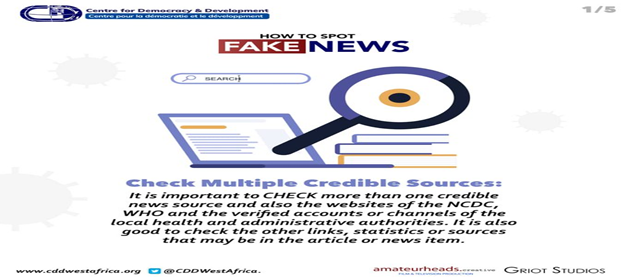
    How NOA’s Public Engaged with other Posts 

    CDD’s Post

    16 posts (31.4% of all relevant tweets) were authored by the CDD and retweeted by the agency. These then generated 186 retweets by NOA’s online public, with 25 comments and 232 likes. Of these 16 posts from CDD, there were 4 videos which generated 1083 viewings.

    Figure 2. Post from CDD, retweeted by NOA

    Figure 3. Post from CDD on June 25, 2020
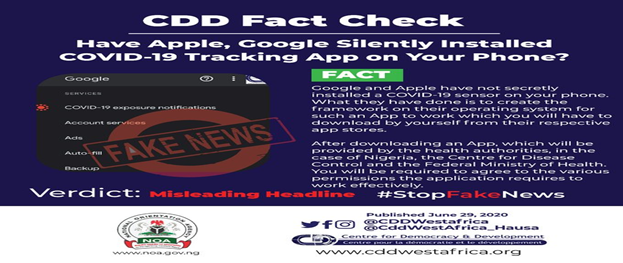
    Figure 4. post from CDD on June 29

    Posts from NCDC

    2 tweets (3.9%) authored by the NCDC were retweeted by NOA. This was retweeted in a frequency of 469 times, with 126 comments and 965 likes. No video. 

    Posts from WHO

    The only one relevant post retweeted from WHO was a video. It generated 109 retweets by NOA’s public with 32 comments and 329 likes. The video generated 2.7 million viewings. Extract from the video is in text below:

    “...As one who had coordinated #COVID-19 response in Lagos with @followlasg, it was easy to see what other people pass through…You can see it’s not a death sentence, listen to experts, stop fake news and #stigmatization– WHO tweet

          (Tweet from WHO and retweeted by NOA on June 6, 2020)

    Post from NHW

    3 tweets from NHW, representing 5.9% of relevant posts were also retweeted by NOA and generated 35 retweets by NOA’s public with 55 likes. No comment. No Video.

    Figure 5: Posts from NWH, retweeted by NOA (July 8, 2020)  

    Post from FMHA

    Only 1 tweet used as media literacy from FMHA, represented 3.7% of relevant posts. It was retweeted by NOA and generated the highest number of 1.5million retweets by NOA’s public with 3000 likes and 444 comments. No Video.

    Post from Presidential Aide

    Another tweet from a presidential aide, Bashir Ahmaad, representing 3.7% of relevant posts was retweeted by NOA and generated the highest number of 2 million ‘likes’ by NOA’s public with 545 ‘retweets’ with 350 comments. No Video.

    As tweeted by @BashirAhmaad:

    Do not let your social media posts be the reason for people to take arms against each other, stop spreading the fake news for a better Nigeria, message from the National Orientation Agency @NOA_Nigeria. 8:25 AM · Nov 2, 2020

    NOA’s Online Engagement: The Director General’s Responses

    As part of the methods of evaluating the Federal Government’s responses to the menace of false information, particularly on social media, this researcher made efforts in reaching the Director General of the National Orientation Agency via e-mail to speak on  the campaign plans of the agency and the methods of executing those campaigns in educating Nigerians on the evil of fake information in the public space. The responses are highlighted below in the form of questions and answers. Here, the researcher’s posers shall be referred to as “Q” while the DG’s responses shall be represented by “Ans”. 

    Q.The agency says (on its website) it has over 5 engagement platforms it uses to reach Nigerians. What are these platforms?

    Ans: The agency reaches Nigerians through a number of platforms. These include the agency’s website (www.noa.gov.ng), as well as through its e-mail (admin@noa.gov.ng). Asides these, the agency also reaches its community through its various social media platforms including Twitter (@NOA_Nigeria), Facebook (National Orientation Agency, Nigeria) and Instagram (noa_nigeria).

    Q. The agency also says it uses 3 major segmentation approaches to do its enlightenment campaigns. What are these approaches? 

    Ans: The agency carries out its enlightenment campaign in three segmental approaches using the National level, State level and the Local government levels which are often undertaken by the Community Orientation and Mobilisation Officers domiciled in all the 774 LGAs and the Federal Capital Territory (FCT). 

    Q. “Fake news” has become endemic in Nigeria. What are the campaign plans the agency has or has been running to carry out enlightenment programmes for Nigerians on its danger and negative impact on our democracy?

    Ans: There are plans which the agency has been exploring to engage Nigerians on various platforms of interaction with a view to bringing to the fore, dangers inherent in the spread of fake news in our society.

    Q. What have been the approaches adopted to carry out these campaigns?

    Ans: We have been developing counter narratives using postcards for social media posts, jingles (both audio and video, community engagement, public enlightenment using the Agency’s Public Address Van, holding workshops/seminar with stakeholders, training of staff on how to identify and respond to fake news as well as preparing questionnaire to get feedback. Also, the Agency regularly organises press conferences to intimate news media on efforts of the Agency regarding fight against fake news and hate messages.

    Q. How does the agency create contents on the platforms earlier highlighted to engage Nigerians on anti-fake campaigns?

    Ans: The Agency generates contents on topical issues of national relevance with a special reference to the feedback mechanism of NOA.

    Q. Do citizens respond to/engage with these contents? What are the pieces of evidence that these campaigns or messages on these platforms resonate with citizens?

    Ans: Robust citizens’ engagement on our online platforms is an evidence that NOA gets responses from the public. We also conduct e-polling to gauge the pulse of people on topical issues. Feedback mechanism by the PRS department also indicates evidence of engagement with Nigerians.

    Q. Are there impacts of these campaigns? 

    Ans: The Agency has been able to effect a new set of values resulting in attitudinal change of citizens regarding fake news. Sustained campaign against fake news has recorded successes especially on social media.

    Q. What have been the noticeable impacts?

    Ans: Some of the noticeable impacts have been attitudinal change and instilled patriotism.

    Q. How does the Agency evaluate its impacts on the citizens?

    Ans: We do this through e-polling and feedback mechanisms of the Agency.

    Q. Does the agency collaborate with other government and non-government agencies to tackle the scourge of misinformation in Nigeria?

    Ans: Yes

    Q. What are these agencies?

    Ans: We collaborate with the Federal Ministry of Information and Culture, FRCN, NTA, Centre for Democracy and Development (CDD), Budgit, Open Government Partnership (OGP) and so on.

    Q. What strategies does the agency use for this collaboration? 

    Ans: Some of our strategies for collaboration include seminars, workshops, sensitisation, community engagement, online engagement and capacity building.

    Discussions 

    This study shows that while the agency created a considerable number of valuable contents on its platform, there was little evidence of sufficient readiness to up-take campaigns on information disorder on social media. This is evident from the fact that only 3.5% (n=1,461) of the total tweets for the period were relevant to fighting fake information online. 

    On the question of partnership, there was evidence of cooperation and  partnership with other public and civil society stakeholders in the campaign against misinformation online as the agency retweeted valuable contents from its online partners.

    Evidence shows that there was a considerable level of cooperation and partnership with other public and civil society stakeholders in the campaign against misinformation online as the agency retweeted valuable contents from its online partners. This corroborates the responses of the director-general of the agency that it has a robust partnership with other stakeholders, such as the Federal Ministry of Information and Culture, FRCN, NTA, Centre for Democracy and Development (CDD), Budgit and Open Government Partnership (OGP). 

    While evidence shows that only the Centre for Democracy and Development (CDD), National Centre for Disease Control (NCDC), World Health Organisation (WHO), Nigeria Health Watch (NHW), and the Federal Ministry of Humanitarian Affairs (FMHA) were active on the agency’s online platform as stakeholders fighting misinformation, result from the tracking of the agency’s twitter handle shows that other key ministries and agencies such as Ministry of Information and Culture were either not working on information disorder online or not creating any contents that resonate with the agency’s effort in fighting misinformation on social media.

    While this study did not find out if the attitude of the agency’s online audience to its contents was  positive or negative, evidence shows that there was a considerable level of engagement with its content by its online community. Although , the director general of the agency observed that the “robust citizens’ engagement on our online platforms is an evidence that NOA gets responses from the public’, result of the tracking of its twitter handle shows that the agency’s online public found contents authored by the agency less valuable and less resonating than contents shared from its partners. As a result, its online public engaged more with posts retweeted from other partners with a range of activities such as “like,” “comment’ and “share”.

    To show that its online engagement with its audience was considerably low, there is more to be desired considering that the agency’s tweets for the seven-months period generated only 964 retweets despite being followed by 155,000 followers online.  Therefore, its claim that it reaches at least 64% Nigerians on its enlightenment campaigns is perhaps, more offline than online. 

    The fact that audience engagement was low also shows that the agency has not really subscribed to the proposition engendered by the Social Media Engagement Theory (SME, Theory) which suggests that “an organisation will be creating a chain of value, experience and benefits when it develops a User-Generated Content (UGC) that resonates with its audience on social media. While observation shows that the agency makes spirited efforts to cover many issues of national importance, its efforts at creating media literacy campaigns and publishing fact-checks on its platforms have been grossly inadequate.

    Similarly, it is not clear how the agency creates content on its social media platforms, although the director-general in an interview revealed that “the agency generates contents on topical issues of national relevance with a special reference to the feedback mechanism of NOA.” Some of these issues of national relevance, as revealed from the tracking exercise adopted for this study, include information disorder around COVID-19, #EndSARS protest, national unity among others. However, the fact that the agency created 24 relevant tweets on media literacy and fact-check (47%) out of the total 51 recorded during the period, shows that it largely depends on other relevant stakeholders to create relevant contents which it retweets for media literacy and fake alert systems.  

    Conclusion and Recommendations

    This study has investigated the level of preparedness and seriousness on the part of the Nigerian government through its ministries and agencies to take its campaign against “fake news” and misinformation to its online and social media community of followers. Deploying the method of social media content analysis of the National Orientation Agency’s twitter handle, the findings of this study show that the federal government, through its agencies has done less to create resonating messages to its online public on anti-fake campaigns. 

    It is also observed that the agency was more interested in media literacy than fact-checking. All the fact-checks tweeted within the period were posted by its other partners including CDD, WHO, NCDC, National Health Watch (NHW) among others. 

    Again, this study shows the federal government depends more on civil society and foreign agencies to wage war against misinformation, given that more of the content posted on the agency’s twitter platform on misinformation were authored by other partners operating within the misinformation ecosystem. 

    The merit in this circumstance is underscored by the evidence that federal agencies are open to cooperation and partnership. Yet it is more worrisome that while the Ministry of Information and Culture had identified National Orientation Agency (NOA) as its key partner in the campaign against fake content in Nigeria, no single relevant tweet was found on the agency’s platform as either created by the Information Ministry or tweeted by any of its officials.  

    This rather illustrates hypocrisy on the part of the Federal Ministry which has bent more towards social media regulations than education of its citizens against the threat of mis/disinformation.

    By recommendation, more study is imperative to investigate what motivates online community of users to engage with messages created and shared on anti- fake campaigns.

     *This study is conducted for the Dubawa Fellowship programme, and is supported by Heinrich Boll Stiftung Foundation Abuja office.

    References:

    Adeniran, R. (2020). “Cure Myths and False Ratings Lead COVID-19 Fact-Checks in Nigeria, With Governments as Most Targeted Entities”. https://dubawa.org/cure-myths-and-false-ratings-lead-covid-19-fact-checks-in-nigeria-with-governments-as-most-targeted-entities/

    Alexander, D.R. (2018). France moves to fight the ‘manipulation of information’ instead of ‘fake news’. https://www.poynter.org/fact-checking/2018/france-moves-to-fight-the-manipulation-of-information-instead-of-fake-news/

    AllAfrica (2020). “Nigeria: Coronavirus – How Nigerian Govt Is Fighting Fake News –   Lai Mohammed”. https://allafrica.com/stories/202004150698.html

    Di Gangi, P.M & Wasko, M. (2016). “Social Media Engagement Theory: Exploring the Influence of User Engagement on Social Media Usage”.https://www.researchgate.net/publication/Social_Media_Engagement_Theory

    Education for Justice (2019). “Information warfare, disinformation and electoral fraud”. https://www.unodc.org/e4j/en/cybercrime/module-14/key-issues/information-warfare–disinformation-and-electoral-fraud.html

    Feikert-Ahalt, C. (2019). “Government Responses to Disinformation on Social Media Platforms: United Kingdom”. https://www.loc.gov/law/help/social-media-disinformation/uk.php

    Daniel, F., & flamini, D. (2018). “A guide to anti-misinformation actions around the world”. https://www.poynter.org/ifcn/anti-misinformation-actions/

    Okakwu, E. (2018). “Nigerian govt launches campaign against ‘fake news” https://www.premiumtimesng.com/news/more-news/275846-nigerian-govt- launches-campaign-against-fake-news.html  

    Raji, R. (2020). “A Six-year Mapping of Fact-Checks Shows Growing Partnership Between Newsrooms and Fact-Checking Organisations in Nigeria”.https://dubawa.org/a-six-year-mapping-of-fact-checks-shows-growing-partnership-between-newsrooms-and-fact-checking-organisations-in-nigeria/

    Being the video by CDD on June 30 and July 1 https://twitter.com/i/status/1278440221378576386

    Being the video of Interview granted to the @Channels Television by the DG of the National Orientation Agency (NOA) (·         https://www.youtube.com/watch?v=YxgDTtJE8AU&feature=youtu.be)

    Ziga, T. (2018). “Technology as Enabler of Fake News and a Potential Tool to Combat It”. https://www.europarl.europa.eu/RegData/etudes/IDAN/2018/619008/IPOL_IDA(2018)619008_EN.pdf

  • Detecting Fake News: Audience Perception of Information Credibility in the Media in Ghana

    Abstract 

    Using a focus group discussion, this study sought to understand how media audiences perceive information in the media environment in Ghana. The study found out that the prevalence of fake news on social media platforms serves as a disincentive to consumers of media messages from giving attention to information from some media platforms.

    Legacy media, radio and television, for many of the participants, presents credible information on its platform with the belief that rigorous scrutiny is done by the media organisation before information is shared with their audiences on air. 

    Though participants in the group discussions are often dismissive of media information they have doubts about, they occasionally, not routinely, verify information from news portals they deem credible. Participants also rely on their intuition to assess the truthfulness or otherwise of a story.

    Keywords: Fake News, Fact-Checking, Credibility, Focus Group 

    Introduction 

    Since the repeal of the Criminal Libel Law in Ghana and the subsequent liberalization of the airwaves, the media landscape in the country has experienced a rise in the number of media outlets. According to Acheampong (2017), Ghanaians witnessed a massive growth of the private media with a rapid expansion of the electronic media after the repeal of the criminal libel law. Acheampong further observes that the repeal engendered an atmosphere of freedom of expression and this enabled the media to provide citizens with timely information to help them make informed choices about their lives.

    As an information source for many, the media, over the years, has created an informed society thus weaponizing its audiences, with information from all across the globe on varied subjects, in order to be active participants in public discourse and decision-making processes. The internet, which abounds with information from all sources on almost all subjects has played the key role in providing unlimited access to information to citizens and it has become the easy to go platform for news at one’s convenience at a relatively minimal cost.

    Pollard & Kavanagh (2019) posit that the use of the internet as a news source is very common among most Americans, however, the print and the broadcast media equally serve as a major news source for a number of American citizens today. However, their study notes that one’s rating of reliability of information from one media outlet or the other is dependent on race, political affiliation and the echo chamber to which one belongs.

    Lazer et al (2017) argue that members in echo chambers for instance have the tendency to consent to information that reinforces their beliefs and their ideological stands. According to Zimmer et al (2019), echo chambers in social media refer to a relatively homogenous social space that reinforces or echoes beliefs and views within one’s like-minded network while omitting or censoring opposing beliefs and views from other individuals or media sources. Arguably, the presence of echo chambers in online spaces is becoming a festering ground for fake news, and Lazer et al (2017) opine that the tendency of people to follow like-minded people leads to the creation of echo chambers and filter bubbles, which exacerbate polarization.

    Extant literature continues to raise doubts about the credibility of information from media sources as the splurge of fake news blurs the lines of credibility and reliability of media information. Often associated with online media, fake news has become a global buzzword (Farkas & Schou, 2018) and its evolution and manifestation were closely linked with the rise of populist politics, digital capitalism, the transformation of the public sphere, and structural weaknesses of liberal and mainstream media (Mare, Mabweazara & Moyo, 2019). 

    Though the concept of fake news is a relatively new phenomenon on online media, its existence predates legacy media (Luciano, 2016). According to Posetti & Matthews (2018), the use of deceptive messages for mass communication is ancient, but never before has there been the technology to so effectively disseminate it. Their study recounts incidents of deceptive messaging from as far back as Circa 44 BC, during the Roman Empire, where  crafted messages in the form of a propaganda campaign deployed Twitter-worthy slogans etched onto coins to smear the reputation of opponents. 

    In recent years, however, the epicentre often associated with narratives on fake news has been the 2016 presidential elections in the United States of America. America’s President, Donald Trump’s wielding of the term in a way to describe news that is unfavourable to himself as fake, is viewed by a satirical news organization, The Onion, as one of three distinct directions of fake news (Purcell, 2017).

    Fake news is not new to the Ghanaian media. According to Ahiabenu, Ofosu-Peasah & Sam (2018), fake news is endemic in the media environment in Ghana and it mostly manifests as fabricated content and false headline without connection to content. The study further argues that as a growing part of the global news ecosystem, the prevalence of fake news has become a commonplace to be associated with adverse impact on citizens’ lack of trust not only in the news media, but also in key governance institutions. 

    Ognyanova et al (2020), in a study to assess the triggers in the rise and the overwhelming preponderance of fake news in media in America, observed that the lack of trust in mainstream media coupled with a rise in the trust of political institutions by those whose biases are aligned to the philosophy of a political organization has provided the grounds for fake news to flourish. The study further asserts that the extent to which fake news can undermine the public’s confidence in mainstream media may not only leave its consumers misinformed but also make them more vulnerable when disaster strikes and may pose a threat to development. 

    Dominant literature makes the point that the prevalence of fake news in the media space continues to erode the trust of audiences in information coming from the media. According to Scheufelea & Krausea (2018), often, media audiences and citizens, in general, are misinformed because they are unable to sift through and critically evaluate information in emerging (social) media environments. 

    Further, Scheufelea & Krausea hold the view that lack of media literacy is one of the reasons why citizens become victims of misinformation in the media. Their study explains that other factors that create victims of media audiences include selective exposure on the part of the audiences, especially those trapped in echo chambers who are more likely to trust in information that reinforces their beliefs and will not give room for dissenting opinions.

    Nielsen & Graves (2017), in a study on audience perspective on fake news, note that the majority of the respondents are of the view that fake news has become more of a political buzzword used by politicians to criticise news media outlets. Invariably, scandalizing the media as a conduit for the propagation of fake news continues to fester and has created an image where media audiences are often at a loss about which media information is so credible enough for them to rely on. Nielsen & Graves (2017)observe that there is a general scepticism about information from media sources and that this is generally affecting the reliability of such information. To believe whether information from the media is true or not, the study observes that consumers of media information rely on their own critical faculties to make sense of what they come across.

    The media in Ghana, according to Ahiabenu, Ofosu-Peasah & Sam (2018) is not sacrosanct in the milieu of fake news publications and, according to Pollard & Kavanagh (2019), more media audiences are beginning to question the credibility of information from media sources. However, media audiences find themselves in a quagmire, often looking for alternative sources considered as more credible sources of information they could rely on. 

    To understand the phenomenon of fake news in the Ghanaian context, this study seeks audience perspective on how credible they perceive information in the media in Ghana and further asks about measures the participants take to authenticate the veracity of information from the media.

    Methodology 

    A focus group is used in this research to understand the audience’s perspective on information credibility in the media. The study also seeks to ascertain media outlets from which participants access information on issues of interest. 

    A publication by the American Statistical Association (1997) asserts that focus groups are an increasingly popular way to learn about opinions and attitudes. Their work affirms that focus group discussions give one a sense of what makes people tick and a sense of what  goes on with people’s minds and lives that the average observer may not get with survey data.

    Two focus groups (called Group one and Group two) were used in this study to gather information on participants’ perception of information credibility in the media in Ghana. According to Masadeh (2012), there is no iron-clad rule about how many focus groups are enough. This study, thus, uses two different focus groups in order to get wide and diverse views on the audience’s perspective of information credibility in the media.  Participants between the ages of 18 and 35 constituted the first group while in group two, participants were those above the age of 35 years. The selection of participants within the age brackets was to ascertain patterns of perception across different age divides and also to find out whether the age bracket into which participants fall have any correlation with their preferred media type.

    The two focus groups had seven participants each. According to Krueger (2002), a focus group with 6 to 10 is ideal but further notes that a range from 6 – 8 is preferred. Masadeh (2012) corroborates the position of Krueger and states that a focus group should have participants between 4 and 12. For this study, the selected number of participants to constitute the groups is consistent with the design of focus group composition as espoused in extant literature.

    People selected as participants are persons who are active users of at least two media platforms for their daily news and other information of interest. The media outlets that participants actively access their information from include television, radio, newspaper, and online media. 

    The discussion was held on zoom, a virtual platform for synchronous meetings. The discussion was recorded for easy reference on comments and statements made by the participants. The study analysed statements and comments (Nili, Tate & Johnstone, 2017) made by the participants in the group in response to questions posed by the moderator. 

    As part of protocols for conducting the group discussion, participants remain anonymous in respect of references to comments made by them during group discussions but are only identified by labels, that is, Participant 1, Participant 2 etc. Together, the two groups had a total of 8 women and 6 men.

    Findings and Discussion

    Participants in all two groups were of the opinion that the prevalence of fake news is a key contributing factor in choosing one media form over the other. Convenience was the other reason why some participants choose other media forms to source their information.  A participant alludes to an instance where she read a news item on social media and later found out that the information shared on the social media platform was false after hearing other angles to the story on other media platforms. 

    “There was a day I read about a story on social media, and somehow became curious and wanted to check whether other media houses have carried the same story. Yes, they have covered it but the slant given to the story I read on social media was not closer to what I read on other platforms. It was so much sensationalized on social media that it was a  departure from what the actual details of the story was”, says Participant 6.

    Another participant agrees that fake news has become a common phenomenon on online spaces but states that his choice of media is influenced by the nature of his daily schedule. 

    “Yes, fake news is true and real in the media today.  But I come to work very early and leave quite late home. In my office, there is nothing like television nor a radio available for me to view or listen. The online comes in handy and has become my primary reference point on a daily basis”, says Participant 9..

    The views of the participants confirm a generally held view that fake news is a common feature in the media environment today and that the media in Ghana is not an exception (Ahiabenu, Ofosu-Peasah & Sam, 2018; Allcott, Gentzkow & Yu, 2018; Lazer, 2017).

    Information Credibility

    All the participants in the groups raised concerns about the credibility of information coming from the media. 

    “I’m careful about the information I consume as a media user. Often, my intuition tells me this story is too sweet to be true”(Participant 4).

    Another participant (Participant 1) notes that “with my knowledge on how the media works, I look out for some key facts in the information such as the source of the information, to ascertain whether it is coming from a credible source or otherwise”.

    The scepticism expressed by the participants in trusting the media with information it publishes confirms the study by Nielsen & Graves that the perceived lack of credibility of media information is eroding the trust of media audiences and spiralling the level of scepticism in media messages. 

    The heightening mistrust in media messages is, as a result of experiences of participants who have read news items that turned out to be false and also heard comments from other media users who have been misled by a news item they read on a media platform. The experiences have created a phenomenon where audiences have become dismissive of information coming from media platforms they perceive to be inundated with fake news. 

    One of the participants (Participant 3) noted that media audiences appear to be in some form of dilemma not with the information from some media outlets, but from the barriers such media outlets pose. 

    “I decided to read a lot of newspapers knowing that they will not publish false information, especially the well-established media organisations in Ghana. But the cost involved in buying a newspaper every day was too expensive for me coupled with the fact that I have to walk some distance to get a newspaper at a newsstand. I have to fall back on social media and sometimes news portals because of the convenience of accessibility though I take information from the internet often with some doubts.”

    Though participants in the two groups unanimously mention social media as being in vogue, it is however perceived as having a lot of untrue and misleading content. “Social media is a jungle where people dump any information they deem fit without any background verification” says Participant 1. This assertion confirms the position of Shu et al (2016) that Social media enables the widespread of fake news, i.e., low-quality news with intentionally false information.

    Media Preference

    Participants mentioned three media platforms they actively use and also source their information from – radio, television and online media. Ironically, missing in the list of media preferences is the newspaper. 

    Online media

    According to a study by Quarshie & Ami-Narh (2012) on the growth and use of internet in Ghana, 45.6% of Ghanaians use the internet frequently for educational purposes, 33.75% frequently use it for news; and only 6.35% frequently use the internet for commerce. Amegatcher (2014) asserts that the majority of Ghanaians who use the internet are often on social media. According to the study, social media platforms are gradually replacing legacy media due to the  ease with which one can access information. Participants in the group discussions have used, and continue to use online media to access information on varied interests. According to Participant 10, “it is the most convenient platform for me to get my information as compared to the rest”. 

    Though the internet is the platform most used as a reference point in accessing information, it is the least trusted by the participants when it comes to the credibility of stories found in the medium. Participant 1 particularly points out social media as a breeding ground for fake news. “I’m often cautious about the information I read there, with experiences of reading false news on such platforms”. 

    Though online media platforms emerge as the most used by participants in this study to access information, Participant 5 for instance shares the views of other members of the group and makes the point that he has confidence in selected online news portals but discounts information on social media as it is often polluted with misinformation.  “I often visit some of the big media houses such as myjoyonline, peacefmonline and citi newsroom to read again a story I have already read on social media to be sure of the truthfulness of the story”

    Radio

    Participants rate radio as one of the credible media platforms in the country and better in terms of the trustworthiness of information emanating from such platforms. “Radio produces very credible information in my view though this is not to say they are perfect. I believe that before information is sent out it goes through a lot of hands to cross-check all necessary facts before it is shared with the audiences’. says Participant 8.

    A study by Adu (2003) about residents in the western part of Ghana on their perception of news credibility of two local FM stations in the region concluded that information emanating on the selected radio stations were highly rated as credible. The study confirms the position of some participants in this study who hold similar views that information on radio has credibility and can be trusted. The inference in this study that alludes to the credibility of information on radio as a result of rigorous scrutiny stories go through is consistent with Adu’s study that respondents cited objectivity, balance, and fairness as reasons for assigning high credibility rating to information on radio as a media platform.

    Access to radio was again acknowledged as a media platform that can be conveniently accessed on a mobile phone; hence it is often, for participants, an easier flip from online media (news portals and social media) to offline media on their phones (radio in this case). ‘Radio as much as online media come in handy and even have the additional advantage of accessing information at no cost,’ says Participant 4. The assertion that one can easily flip from online to offline on their phones to listen to radio was articulated by the first group of participants who are within the age bracket of 18-35 years. The second group of participants, (35 years and above) while agreeing that information on radio has a high level of credibility, they get little time to listen to radio. “Because of my work schedule I only get to listen to the radio only on my way to work while driving and a few times in my office” (Participant 8).

    Television

    Television is one medium mentioned by a participant in the group discussion as having credibility in terms of the information shared with its audiences on the platform. A report by the licensing authority in Ghana, the National Communication Authority (2017), indicates that there are 128 television stations licensed to operate in Ghana and of this number, 53 are operational while the remaining 75 are presently not on air. Television was not frequently viewed, as observed by one participant (Participant 3) because it is quite expensive to own one. In addition, the issue of its portability makes television a difficult option for accessing information with the ease of doing so with online media and radio.

    According to the Ghana Media Measurement Report (2020), as cited by Koney (2020), TV3, United Television and Adom TV have the highest number of audience share across the country. It was noted in the discussion that participants who watched television as one of the platforms where they accessed information often referred to TV3 or United Television as television networks they watch for their news and other information of interest. The reference to these television networks with the highest number of viewership reinforces their dominance in the television media spectrum in Ghana. Participant’s affirmation that  the credibility of information from such sources as TV3 and United Television is a reflection of the level of trust in information coming from such media platforms.

    Information Authentication

    The findings from the focus group discussion show that the majority of the participants have not developed any means by which they ascertain the veracity of the information they come across in the media nor do they rely on any fact-checking website organisation to verify the truth or the falsity of media information. In instances where a person is doubtful of information, he dismisses it outrightly without any rigorous fact-check or reference to a third party for assistance to ascertain the truthfulness or otherwise of a story. “I’m aware of fake news particularly on social media but I have no knowledge of any organization that is into fact-checking and I either read from reputable online news portals to verify the story or I don’t believe it” says Participant 10. .

    A member of the group who asserted that he occasionally tries to verify information from the media, though not as a routine, says ‘it is often the case that I fall on other news portals such as Citinewsroom or myjoyonline to ascertain the veracity of a news story I read on social media. If these news portals have not reported on them, I consider them as fake news” (Participant 3).. Authenticating news or information on a media platform is done based on one’s intuition. So for the members in the group discussion, if they have doubt about a story, they dismiss it as false, giving no credence to it at all.

    This insight shared by the group members reinforces the position by Scheufelea & Krausea (2018) that media audiences usually rely on their own critical thinking to sift information to determine whether to accept a story as true or false.  Their study argues that media audiences eventually adopt a dismissive approach to media messages they are not sure of. This development, as noted, in their study, can be detrimental to human and societal development where important information may be discounted because a media consumer has doubts over its credibility.

    Participant’s reference to online news portals as a means of verification is a reflection of trust in some selected online media platforms though the general view of the online space being inundated with fake news continues to cast doubt over the credibility of information on online platforms. This phenomenon of cross checking information from one media platform on another media platform goes to indicate how the internet serves as its own check and balances. The absence of the practice where information in doubt from the media is not verified from an identifiable fact-checking website puts media consumers in a position where they are either dismissive of information they doubt or open themselves up to be served with a myriad of information of which some may be fake news.

    Age and Media Preference

    The study constituted two different focus groups with 7 participants each. Group one which had participants with the age bracket of 18-35 are mostly students of tertiary institutions. Use of Online platform to access information is a regular practice. Participants from age 36 and above constituted Group Two and like Group One, online media is their easy to go place to access information. All members in Group two are in the working class and their preference of online over other forms is the convenience of access it offers though members of this group are often skeptical of the credibility of information emanating from social media. 

    The use of online media to access information is a common practice by all participants across the age brackets in this study. However, participants in Group Two, most in the working class, are motivated by the convenience the internet offers them to source their information. Although the preference for legacy media is key, daily work schedules are a barrier to access information on their preferred media platform. Participant 10 notes for instance that “I like TV because of the pictures that accompany the story read on screen. it assures me of truth in the story”. Group One is motivated to use more online sources irrespective of the risk of exposure to fake news simply because of ease of access. “It is less expensive and very easy to access a lot of information fast”, notes Participant 1. 

    Conclusion

    It is evident from the study that the phenomenon of fake news is widespread on all media platforms in Ghana. This has largely affected the level of trust media audiences have in information coming from the media, especially online media.

    Fact-checking is an activity that is casually undertaken by the participants even though organisations and websites exist in the country to assist media consumers to authenticate information from the media they have doubts about. 

    The evaluation of legacy media (radio and television) as a platform that shares credible information on the basis that they undertake rigorous checks before sharing information with the general public points to a reliance on third parties to do a thorough check before putting out messages on a media platform for public consumption.

    Though the internet is noted to be a convenient means to access information on mobile phones especially, because of the multi-mediality of mobile phones, where a legacy media like radio can also be accessed on them, it becomes easy ‘weapon’ for media audiences to analyse, evaluate, and make an informed judgment on whether information emanating from the media space is true or false.

    With media audiences getting information from different media sources at the same time, their preferences of one media form over the other is an indication of their trust in that media outlet. Radio, television, and online portals stand out as platforms that media audiences give credibility for information emanating from such sources. While radio and television are trusted for the information they share, online portals are used by media audiences as a quasi-fact-checking tool.

    Recommendation

    The dismissive approach adopted by media users especially in instances where they have doubts about a story published in the media can be addressed by enhancing education on basic media literacy. Such educational programmes can be undertaken by media institutions and given voice in media spaces as well.

    The evidence that media audiences rely on third parties for verification of information  provides an opportunity for fact-checking organisations to fill this gap in order to rebuild the confidence in the audiences of resources available for them to utilize in order to make informed decisions.

    With evidence of fake news on media platforms in Ghana, media managers will need to do a thorough scrutiny of messages they put on their platforms for audience consumption. As media consumers build their trust in one media form or the other, the media house stands to benefit from listeners or viewers and this will largely translate into attracting advertisement to increase revenue.

    References

    Allcott, H., Gentzkow, M. & Yu, C (2018). Trends in the Diffusion of Misinformation on 

    Social Media. Retreived From https://web.stanford.edu/~gentzkow/research/fake-news-trends.pdf?mod=article_inline

    Amegatcher, K. A. (2014). Social Media in Ghana’s Legacy Media Industry: Collecting 

    “Likes” Or Building a New Revenue Source? Dissertation submitted to the Department of Business Administration, Ashesi University College In partial fulfilment of the requirements for the award of Bachelor of Science degree in Management Information Systems. Retrieved from https://air.ashesi.edu.gh/bitstream/handle/20.500.11988/57/anna.amegatcher—Amegatcher%20Anna%20-%20Thesis_397.pdf?sequence=1&isAllowed=y

    Charles Purcell, C. (2017). The Onion: inside the biggest ‘fake news’ outlet in the world. The Sunday morning herald. Retrieved from https://www.smh.com.au/entertainment/the-onion-inside-the-biggest-fake-news-outlet-in-the-world-20170822-gy1chg.html

    Farkas, J & Jannick Schou, J (2018). Fake News as a Floating Signifier: Hegemony, 

    Antagonism and the Politics of Falsehood, Javnost – The Public, 25(3), 298-314. Retrieved from file:///C:/Users/NII/Desktop/fake%20news/Farkas-and-Schou-2018.pdf

    Floridi, L. (2016). Fake News and a 400-year-old problem: We need to resolve the “post- 

    truth” crisis.” The Guardian, November 29. Retrieved from https://www. theguardian.com/technology/2016/nov/29/fake-news-echo-chamber-ethics-infosphere- internet-digital.

    Gibbs, A. (1997). Focus groups. Social Research Update, 19. Retrieved from

    http://sru.soc.surrey.ac.uk/SRU19.html

    Krueger, R. A. (2002). Designing and Conducting Focus Group Interviews. Retrieved from

    https://www.eiu.edu/ihec/Krueger-FocusGroupInterviews.pdf

    Nelson, L. & Taneja, H. (2018). The small, disloyal fake news audience: The role of audience availability in fake news consumption. Retrieved from https://journals.sagepub.com/doi/abs/10.1177/1461444818758715?journalCode=nmsa

    Nielsen, K. R & Graves L. (2017). News you don’t believe”: Audience perspectives on fake 

    news. Fact sheet of Reuter Institute and University of Oxford. Retrieved from https://reutersinstitute.politics.ox.ac.uk/sites/default/files/2017-10/Nielsen%26Graves_factsheet_1710v3_FINAL_download.pdf 

    Nili, A., Tate, M., & Johnstone, D. (2017) “A Framework and Approach for Analysis of Focus 

    Group Data in Information Systems Research,” Communications of the Association for Information Systems: Vol. 40(1). Retrieved from https://core.ac.uk/download/pdf/193262384.pdf

    Mare, A. & Mabweazara W.H & Dumusani Moyo, D. (2019). “Fake News” and Cyber-

    Propaganda in Sub-Saharan Africa: Recentering the Research Agenda, African Journalism Studies, 40(4), 1-12. Retrieved from file:///C:/Users/NII/Desktop/fake%20news/Fake%20News%20and%20Cyber%20Propaganda%20in%20Sub%20Saharan%20Africa%20Recentering%20the%20Research%20Agenda.pdf

    Masadeh, A. M. (2012). Focus Group: Reviews and Practices. International 

    Journal of Applied Science and Technology Vol. 2 (10). Retrieved From http://www.ijastnet.com/journals/Vol_2_No_10_December_2012/9.pdf

    Methods American Statistical Association. (1997). Survey Research Methods. American 

    Statistical Association, 1429 Duke Streett Alexandria, VA. Retrieved from http://www.prm.nau.edu/prm447/asa%20brochures/focusgroups.pdf

    Ognyanova, K., Lazer, D., Robertson, R. E., & Wilson, C. (2020). Misinformation in action: Fake news exposure is linked to lower trust in media, higher trust in government when your side is in power. The Harvard Kennedy School (HKS) Misinformation Review, Volume 1(4)

    Pollard, M. & Kavanagh, J. (2019). Profiles of News Consumption, Platform Choices, 

    Perceptions of Reliability and Partisanship. Published by the RAND Corporation, Santa Monica, Calif. Retrieved from https://www.rand.org/pubs/research_reports/RR4212.html

    Posetti, J & Matthews, A. (2018). A short guide to the history of ’fake news’ and 

    disinformation. International Centre for Journalists. Retrieved From file:///C:/Users/NII/Desktop/fake%20news/cartoons/cartoons/A%20Short%20Guide%20to%20History%20of%20Fake%20News%20and%20Disinformation_ICFJ%20Final.pdf

    Shu, K, Sliva, A, Wang, S, Tang, J, & Liu, H. (2018). Fake News Detection on Social Media: A 

    Data Mining Perspective. SIGKDD Explorations, 19(1). Retrieved from http://users.wpi.edu/~kmus/ECE579M_files/ReadingMaterials/fake_news[1828].pdf

    Scheufelea A. D & Krausea M. N (2019), Science audiences, misinformation, and fake news. 

    Paper presented at the Arthur M. Sackler Colloquium of the National Academy of Sciences, Washington, DC. Retrieved from https://www.pnas.org/content/pnas/116/16/7662.full.pdf

    Quarshie, O. H & Ami-Narh, J. (2012). The Growth and Usage of Internet in Ghana. Journal of Emerging Trends in Computing and Information Sciences, Vol 3 (9). Retrieved from https://www.researchgate.net/publication/280562028_The_Growth_and_Usage_of_Internet_in_Ghana

    Victoria Nana Ama Figyina Adu, F. A. N. V. (2003). Issues of Credibility in Radio News: 

    Sunyani Residents’ Perception of Sky FM and Radio Bar News. Thesis Submitted to the University Of Ghana, Legon. Retreived from http://ugspace.ug.edu.gh/bitstream/handle/123456789/34227/Issues%20Of%20Credibility%20In%20Radio%20News%20Sunyani%20Residents%27%20Perception%20Of%20Sky%20FM%20And%20Radio%20Bar%20News%20Bulletins.pdf?sequence=1&isAllowed=y

    Download a PDF version below

Back to top button